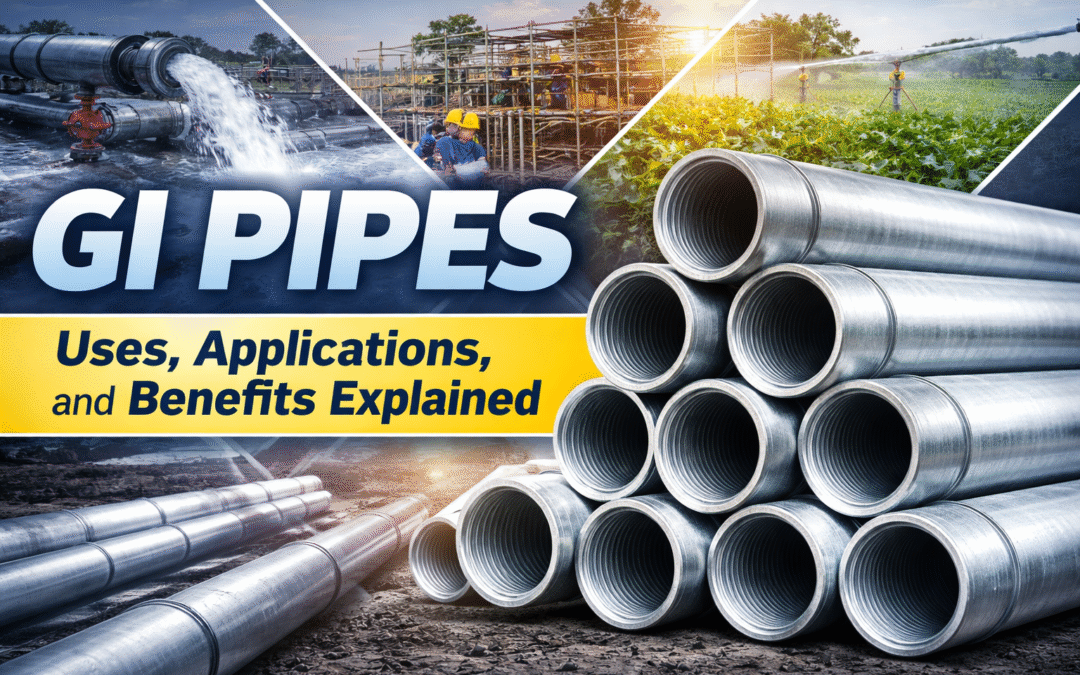
GI Pipes Uses Applications and Benefits Explained is a complete guide to help buyers understand what GI pipes are, where they are used, and why they remain one of the most trusted piping materials in India. From water supply and construction to agriculture and infrastructure, GI pipes offer durability, corrosion resistance, and long service life. This blog explains their real-world value and how choosing the right supplier impacts performance.
Contents
- 1 TL;DR
- 2 Introduction
- 3 What Are GI Pipes?
- 4 Why GI Pipes Are Still Widely Used
- 5 Key Properties of GI Pipes
- 6 GI Pipe Classifications
- 7 Why Buyers Need a Clear Understanding Early
- 8 Role of the Right Distributor in Application Success
- 9 Different Types of GI Pipes Used in India
- 10 Appliactions of GI Pipes
- 10.1 GI Pipes Uses Applications and Benefits Explained in Water Supply Systems
- 10.2 GI Pipes Uses Applications and Benefits Explained in Plumbing and Drainage
- 10.3 GI Pipes Uses Applications and Benefits Explained in Construction and Structural Work
- 10.4 GI Pipes Uses Applications and Benefits Explained in Agriculture and Irrigation
- 10.5 GI Pipes Uses Applications and Benefits Explained in Industrial Environments
- 10.6 GI Pipes Uses Applications and Benefits Explained in Fire Safety Systems
- 10.7 GI Pipes Uses Applications and Benefits Explained in Infrastructure Projects
- 11 Why GI Pipes Remain Relevant Today
- 12 Why GI Pipes Continue to Be a Reliable Choice Across Projects
- 13 Importance of Correct Selection and Installation
- 14 Conclusion
TL;DR
- GI pipes are steel pipes coated with zinc to prevent rust
- They are widely used in water supply, plumbing, construction, and agriculture
- Corrosion resistance is the biggest advantage of GI pipes
- Correct pipe class and thickness matter for performance
- Supplier quality affects durability and compliance
- GI Pipes Uses Applications and Benefits Explained helps buyers choose confidently
Introduction
GI Pipes Uses Applications and Benefits Explained is becoming an important topic for builders, contractors, engineers, and buyers across India. As construction and infrastructure projects increase, the demand for pipes that can handle moisture, pressure, and long-term use has grown rapidly. GI pipes continue to be a preferred choice because they balance strength, corrosion resistance, availability, and cost.
Galvanized Iron pipes, commonly known as GI pipes, are used in both small residential projects and large infrastructure developments. Their zinc coating protects the steel beneath from rust and environmental damage, making them suitable for indoor and outdoor applications. This makes them especially valuable in Indian conditions, where humidity, water exposure, and temperature changes are common.
Many project failures occur not because of design errors, but due to poor material selection. Understanding GI Pipes Uses Applications and Benefits Explained allows buyers to avoid such risks by choosing the right pipe type for the right application. From water supply lines to fencing and structural support, GI pipes play a role in everyday systems that people rely on without noticing.
Equally important is sourcing. Even the best material can fail if it is poorly manufactured or improperly stored. This is why experienced buyers prefer working with a top GI and MS pipe distributor in Chennai who can ensure consistent quality, proper certification, and reliable supply.
This blog is designed to explain GI pipes in simple terms. It focuses on what they are, why they are used, and how buyers can make informed decisions. Each part of the blog builds clarity step by step, so readers can understand both technical and practical aspects without confusion.
What Are GI Pipes?
GI pipes are mild steel pipes coated with a layer of zinc through a galvanization process. This zinc layer acts as a protective barrier, preventing rust and corrosion when the pipe comes in contact with water, air, or soil. Because of this coating, GI pipes last significantly longer than untreated steel pipes in similar conditions.
The manufacturing process involves dipping steel pipes into molten zinc, which forms a bonded coating on the surface. This coating does not just sit on the pipe; it becomes part of the steel surface, offering long-term protection. This is one of the main reasons GI Pipes Uses Applications and Benefits Explained is relevant across so many industries.
GI pipes are available in different diameters, thicknesses, and pressure classes. These variations allow them to be used for multiple purposes, ranging from domestic plumbing to industrial pipelines. The choice of pipe depends on where it will be used, how much pressure it needs to handle, and how much exposure it has to moisture.
In India, GI pipes are commonly manufactured according to Indian Standards, which define dimensions, weight, coating thickness, and performance requirements. Buyers working with a top GI and MS pipe distributor in Chennai usually receive pipes that comply with these standards, ensuring safety and durability.
Why GI Pipes Are Still Widely Used
Despite the availability of newer materials like PVC, CPVC, and HDPE, GI pipes continue to hold strong demand. GI Pipes Uses Applications and Benefits Explained helps clarify why this material has remained relevant for decades.
One major reason is reliability. GI pipes perform consistently over long periods, especially in water-related applications. They can handle pressure better than many plastic alternatives and are less prone to damage from external impact.
Another reason is versatility. GI pipes can be threaded, welded, or joined using standard fittings. This flexibility makes them easier to work with across different types of projects. Contractors also prefer them because they are familiar, predictable, and widely available.
Cost efficiency over time is another factor. While GI pipes may cost more initially than some alternatives, their longer lifespan and lower failure rates often make them more economical in the long run. This is especially true when sourced from a top GI and MS pipe distributor in Chennai that maintains consistent quality.
Key Properties of GI Pipes
Understanding the core properties helps explain GI Pipes Uses Applications and Benefits Explained more clearly.
Corrosion Resistance
The zinc coating protects the steel from rust, making GI pipes suitable for water supply, outdoor installations, and underground use.
Strength
GI pipes retain the mechanical strength of steel, allowing them to handle pressure and structural loads better than many non-metal pipes.
Durability
When installed and maintained properly, GI pipes can last for decades without significant degradation.
Ease of Installation
They can be cut, threaded, bent, and connected using standard tools and fittings.
Availability
GI pipes are widely stocked by most suppliers, especially by any established top GI and MS pipe distributor in Chennai.
GI Pipe Classifications
To fully understand GI Pipes Uses Applications and Benefits Explained, it is important to know that GI pipes are not all the same. They are generally available in three main classes:
Light Class
Used for low-pressure applications such as domestic water supply and small plumbing lines.
Medium Class
Suitable for commercial buildings, moderate pressure systems, and general construction use.
Heavy Class
Designed for high-pressure applications such as fire-fighting systems, industrial pipelines, and infrastructure projects.
Choosing the wrong class can lead to leakage, failure, or reduced lifespan. This is why technical guidance from a top GI and MS pipe distributor in Chennai is often valuable for buyers.
Why Buyers Need a Clear Understanding Early
Many buyers make decisions based only on price or availability. However, GI Pipes Uses Applications and Benefits Explained shows that long-term performance depends on correct selection, proper handling, and reliable sourcing.
Understanding GI pipes early in the planning stage helps prevent future maintenance issues, safety risks, and replacement costs. It also ensures compliance with building and safety norms.
Why GI Pipes Are Still Preferred Over Alternatives
Despite the rise of plastic and composite materials, GI Pipes for Water Construction and Industrial Use remains relevant due to:
• Long service life
• Higher pressure handling
• Better resistance to physical damage
• Proven performance over decades
While alternatives may suit specific cases, GI pipes remain the backbone for many water and construction systems, especially in projects requiring reliability and regulatory compliance.
Role of the Right Distributor in Application Success
No matter how good the product is, poor supply can affect performance. Choosing a top GI and MS pipe distributor in Chennai ensures:
• Correct pipe class selection
• Genuine IS-certified products
• Consistent coating quality
• Timely delivery for projects
This directly impacts the success of GI Pipes for Water Construction and Industrial Use across all sectors.
Why Buyers Need a Clear Understanding Early
Many buyers make decisions based only on price or immediate availability. However, GI Pipes Uses Applications and Benefits Explained clearly shows that long-term performance depends on correct pipe selection, suitable application, and proper sourcing.
Understanding GI Pipes Uses Applications and Benefits Explained at the planning stage helps prevent future maintenance problems, safety risks, and unexpected replacement costs. It also ensures that projects comply with construction, plumbing, and safety norms from the beginning.
Different Types of GI Pipes Used in India
To fully understand GI Pipes Uses Applications and Benefits Explained, it is important to know that GI pipes are not a one-size-fits-all solution. They are manufactured in different classes and thicknesses to suit specific pressure, load, and environmental conditions.
In India, GI pipes are commonly available in:
- Light Class (A-Class)
- Medium Class (B-Class)
- Heavy Class (C-Class)
Each category plays a specific role in GI Pipes Uses Applications and Benefits Explained, depending on where and how the pipe is installed.
Light class GI pipes are generally used for low-pressure water lines, temporary connections, and domestic plumbing. Medium class pipes are suitable for commercial buildings, moderate-pressure systems, and general construction. Heavy class GI pipes are designed for fire-fighting lines, industrial pipelines, and infrastructure projects where durability and pressure resistance are critical.
Appliactions of GI Pipes
GI Pipes Uses Applications and Benefits Explained in Water Supply Systems
One of the most common examples of GI Pipes Uses Applications and Benefits Explained is in water supply networks. GI pipes are widely used in both urban and rural water distribution because the zinc coating protects the internal steel surface from rust and contamination.
Water supply applications include:
- Municipal water pipelines
- Residential water connections
- Overhead tank inlet and outlet lines
- Underground water transport
Because GI pipes maintain water quality over long periods, engineers continue to rely on them. GI Pipes Uses Applications and Benefits Explained highlights how proper coating thickness and dimensional accuracy reduce leakage risks and long-term maintenance issues.
GI Pipes Uses Applications and Benefits Explained in Plumbing and Drainage
Plumbing remains a key segment of GI Pipes Uses Applications and Benefits Explained. GI pipes are still widely used in buildings where durability, pressure resistance, and corrosion control are required, especially in commercial properties and older constructions.
Common plumbing uses include:
- Bathroom and kitchen supply lines
- External drainage pipelines
- Vent lines
- Utility plumbing in commercial buildings
Unlike many alternatives, GI pipes can handle higher temperatures and pressure variations. GI Pipes Uses Applications and Benefits Explained shows that correct threading and joint quality are essential to prevent failures during installation.
GI Pipes Uses Applications and Benefits Explained in Construction and Structural Work
Construction sites rely heavily on GI Pipes Uses Applications and Benefits Explained, not only for water movement but also for temporary and semi-permanent structures.
In construction, GI pipes are commonly used for:
- Scaffolding systems
- Safety railings
- Temporary site fencing
- Lightweight structural supports
GI pipes are preferred because they combine strength with resistance to outdoor exposure. GI Pipes Uses Applications and Benefits Explained demonstrates why GI pipes perform better than uncoated steel when stored or used in open construction environments.
GI Pipes Uses Applications and Benefits Explained in Agriculture and Irrigation
Agriculture is another major area where GI Pipes Uses Applications and Benefits Explained becomes highly relevant. GI pipes are widely used on farms due to their ability to withstand soil contact, moisture, and continuous water flow.
Agricultural applications include:
- Irrigation pipelines
- Sprinkler systems
- Borewell casing pipes
- Water distribution channels
GI Pipes Uses Applications and Benefits Explained highlights that GI pipes offer long service life even in rural conditions where maintenance access is limited.
GI Pipes Uses Applications and Benefits Explained in Industrial Environments
Industrial facilities depend on GI Pipes Uses Applications and Benefits Explained for internal systems that require safe and consistent movement of fluids and air.
Industrial applications include:
- Compressed air pipelines
- Coolant lines
- Non-aggressive chemical transfer
- Utility water systems
The zinc coating protects against corrosion caused by moisture and industrial exposure. GI Pipes Uses Applications and Benefits Explained emphasizes that certified GI pipes are essential for audit compliance and operational safety.
GI Pipes Uses Applications and Benefits Explained in Fire Safety Systems
Fire safety is one of the most critical areas covered under GI Pipes Uses Applications and Benefits Explained. Any failure in these systems can result in serious safety risks.
GI pipes are commonly used for:
- Fire hydrant networks
- Sprinkler systems
- Wet riser pipelines
- Pump room connections
Heavy class GI pipes are preferred because they can withstand high pressure during emergencies. GI Pipes Uses Applications and Benefits Explained clearly shows why fire safety consultants insist on high-grade, certified GI pipes.
GI Pipes Uses Applications and Benefits Explained in Infrastructure Projects
Large infrastructure projects rely heavily on GI Pipes Uses Applications and Benefits Explained due to durability, compliance, and long-term performance.
Infrastructure applications include:
- Public water supply schemes
- Sanitation pipelines
- Utility conduits
- Rural development projects
Government and public projects often mandate IS-compliant GI pipes. GI Pipes Uses Applications and Benefits Explained underlines the importance of selecting pipes that meet national standards.
Why GI Pipes Remain Relevant Today
Despite newer materials entering the market, GI Pipes Uses Applications and Benefits Explained confirms that GI pipes remain essential because of:
- Long service life
- Higher pressure handling
- Resistance to physical damage
- Proven performance over decades
While alternatives may suit niche applications, GI Pipes Uses Applications and Benefits Explained shows that GI pipes continue to be a backbone material for water, construction, and infrastructure systems.
Why GI Pipes Continue to Be a Reliable Choice Across Projects
Even with newer piping materials entering the market, GI Pipes Uses Applications and Benefits Explained clearly shows why galvanized iron pipes remain a trusted solution across water, construction, agriculture, and industrial sectors. Their long-standing performance record, strength, and corrosion resistance make them dependable for projects where safety and longevity matter more than short-term cost savings.
GI pipes are especially valued in applications that demand durability under pressure, exposure to moisture, or outdoor conditions. From municipal water lines to fire safety systems, GI pipes have proven their ability to perform consistently over decades when selected and installed correctly.
One of the key takeaways from GI Pipes Uses Applications and Benefits Explained is that these pipes are not limited to a single function. Their versatility allows them to serve multiple purposes across different industries without frequent replacements or upgrades. This adaptability reduces long-term maintenance costs and minimizes operational disruptions.
Quick read on why to buy pipes from authrized dealers by Khandelwal Pipe Syndicate.
Long-Term Benefits of Using GI Pipes
Understanding GI Pipes Uses Applications and Benefits Explained also highlights the practical advantages that influence buyer decisions:
• Strong resistance to corrosion due to zinc coating
• Ability to handle moderate to high pressure
• Long service life in both indoor and outdoor environments
• Better resistance to physical impact compared to plastic pipes
• Compliance with safety and construction standards
• Suitable for water, air, structural, and utility applications
These benefits explain why GI pipes continue to be specified in engineering drawings and project tenders even today.
Importance of Correct Selection and Installation
Another important point in GI Pipes Uses Applications and Benefits Explained is that performance depends heavily on choosing the correct pipe class and installing it properly. Using light class pipes in high-pressure systems or improper jointing can reduce lifespan, even with good-quality material.
Correct selection ensures:
• Reduced leakage risks
• Better pressure handling
• Lower maintenance requirements
• Improved safety compliance
Early understanding of application needs prevents costly corrections later in the project lifecycle.
Conclusion
GI Pipes Uses Applications and Benefits Explained makes it clear that GI pipes remain a practical, durable, and reliable choice for a wide range of applications. Their corrosion resistance, strength, versatility, and long service life make them suitable for water supply, construction, agriculture, industry, and infrastructure projects.
When selected correctly and sourced from reliable suppliers, GI pipes help reduce project risks, maintenance costs, and system failures. Understanding their applications and benefits early allows buyers, engineers, and contractors to make informed decisions that support long-term project success.
GI pipes are not just a traditional choice, they are a proven solution that continues to meet modern construction and industrial demands.