
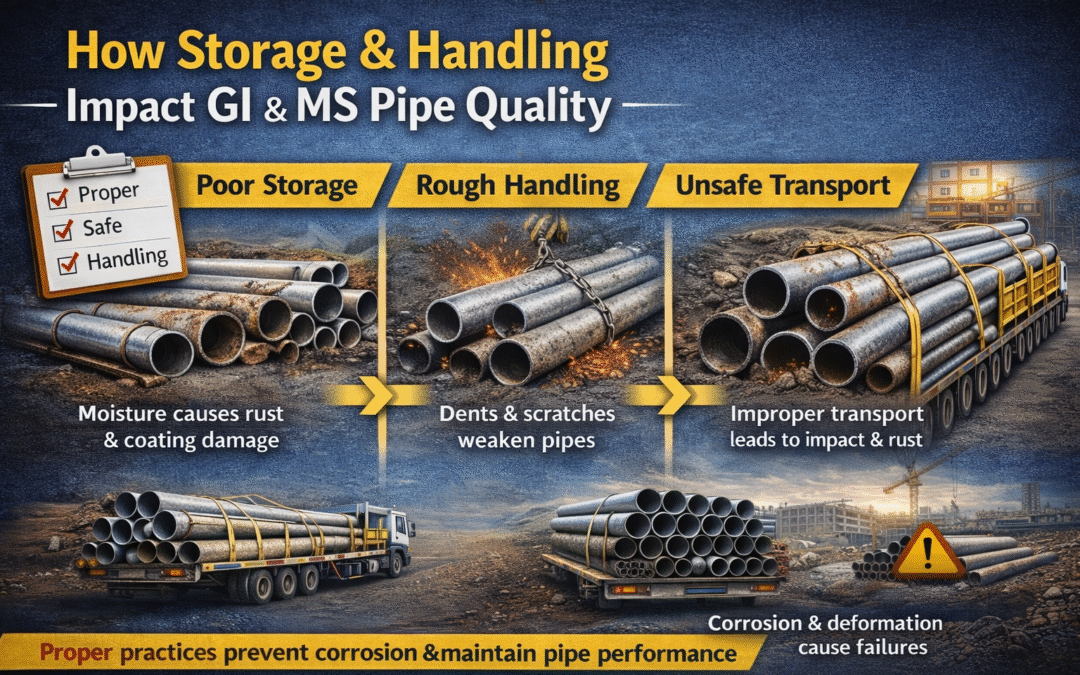
In the pipe distribution and construction industry, product quality is not determined by manufacturing alone. How Storage & Handling Impact GI & MS Pipe Quality is a critical factor that directly affects pipe strength, corrosion resistance, lifespan, and site performance. Even BIS-certified GI and MS pipes can suffer damage, rusting, or deformation if they are poorly stored, mishandled, or transported without proper precautions.
For contractors, builders, and industrial buyers, understanding How Storage & Handling Impact GI & MS Pipe Quality helps prevent costly material rejection, rework, and safety risks. This is also why working with a top GI & MS pipe distributor in Chennai matters—because professional distributors follow strict storage and logistics standards to protect pipe quality end to end.
This blog explains in detail how storage conditions, handling methods, and transportation practices influence GI and MS pipe performance in real-world projects.
Contents
- 1 TL;DR
- 2 Introduction: Why Storage and Handling Matter More Than You Think
- 3 Understanding the Nature of GI & MS Pipes
- 4 How Improper Storage Affects GI & MS Pipe Quality
- 5 Effect of Sunlight and Temperature Variations
- 6 Handling Practices That Damage Pipe Quality
- 7 Why Quality Damage Is Often Invisible Initially
- 8 Role of the Distributor in Preserving Pipe Quality
- 9 Why Buyers Should Care About These Practices
- 10 Why Storage Is a Critical Quality Factor
- 10.1 Impact of Improper Storage on GI Pipes
- 10.2 Impact of Improper Storage on MS Pipes
- 10.3 Indoor vs Outdoor Storage: What Makes the Difference
- 10.4 Importance of Ground Clearance and Stacking Methods
- 10.5 Moisture Control and Ventilation
- 10.6 Storage Duration and Stock Rotation
- 10.7 Why Buyers Should Care About Storage Practices
- 10.8 Storage Standards Followed by Professional Distributors
- 10.9 Transportation: The Most Overlooked Risk Factor
- 10.10 Common Transportation-Related Damage in GI & MS Pipes
- 10.11 Role of Proper Loading and Unloading
- 10.12 Environmental Exposure During Transit
- 10.13 Impact of Poor Transportation on Project Costs
- 10.14 Long-Term Performance Depends on Early Care
- 10.15 Distributor Responsibility in Quality Preservation
- 10.16 Site-Level Transportation and Movement
- 10.17 Why Transportation Completes the Quality Chain
- 10.18 Long-Term Business Impact of Poor Storage and Handling
- 10.19 Why Reputed Distributors Follow Strict Handling Protocols
- 10.20 Storage & Handling as a Quality Assurance Tool
- 10.21 What Buyers Should Ask Before Purchasing Pipes
- 10.22 Future Outlook: Why This Topic Matters More Than Ever
- 11 Conclusion
- 12 FAQs
TL;DR
- How Storage & Handling Impact GI & MS Pipe Quality affects corrosion, strength, and usability
- Poor storage can damage zinc coating on GI pipes and cause rust in MS pipes
- Improper handling leads to dents, bends, and coating failures
- Transportation without protection increases rejection and project delays
- A top GI & MS pipe distributor in Chennai ensures proper storage and safe logistics
- Correct practices extend pipe life and maintain BIS compliance
Introduction: Why Storage and Handling Matter More Than You Think
Many buyers assume that once GI or MS pipes leave the factory, their quality remains unchanged. In reality, How Storage & Handling Impact GI & MS Pipe Quality is just as important as manufacturing standards. Pipes are vulnerable to environmental exposure, physical stress, and poor logistics throughout the supply chain.
GI pipes rely on a uniform zinc coating for corrosion resistance. MS pipes depend on surface integrity and structural consistency. When pipes are stacked incorrectly, exposed to moisture, or mishandled during loading and unloading, their performance degrades—sometimes before they even reach the project site.
This is where experienced suppliers stand out. A top GI & MS pipe distributor in Chennai understands that protecting pipe quality after manufacturing is a responsibility, not an afterthought.
Understanding the Nature of GI & MS Pipes
To fully grasp How Storage & Handling Impact GI & MS Pipe Quality, it’s important to understand the basic characteristics of these materials.
GI Pipes
- Made from mild steel with a zinc coating
- Zinc layer protects against corrosion
- Coating is sensitive to scratches, abrasion, and chemical exposure
MS Pipes
- Made from low-carbon steel without protective coating
- Highly strong and weldable
- Extremely prone to rust if exposed to moisture
Because of these differences, GI and MS pipes require different—but equally careful—storage and handling approaches. A top GI & MS pipe distributor in Chennai designs storage systems that address both material types separately.
How Improper Storage Affects GI & MS Pipe Quality
One of the most overlooked aspects of How Storage & Handling Impact GI & MS Pipe Quality is storage environment.
Moisture Exposure
- GI pipes stored in damp areas can develop white rust (zinc oxidation)
- MS pipes exposed to humidity begin surface rusting quickly
- Ground contact accelerates corrosion in both pipe types
This is why a top GI & MS pipe distributor in Chennai always stores pipes on raised platforms with proper drainage.
Incorrect Stacking
- Excessive stacking causes deformation and ovality
- Uneven loads damage pipe edges and coatings
- Long-term pressure weakens structural integrity
Improper stacking directly compromises How Storage & Handling Impact GI & MS Pipe Quality, especially for large-diameter or thin-wall pipes.
Effect of Sunlight and Temperature Variations
Environmental exposure plays a major role in How Storage & Handling Impact GI & MS Pipe Quality.
- Prolonged sunlight can weaken zinc coating over time
- Temperature fluctuations cause expansion and contraction
- Condensation forms inside pipes stored outdoors
Professional yards operated by a top GI & MS pipe
distributor in Chennai use covered storage areas to minimize these risks.
Handling Practices That Damage Pipe Quality
Handling errors are a major contributor to quality degradation. Understanding How Storage & Handling Impact GI & MS Pipe Quality means recognizing common mistakes during loading and unloading.
Manual Dragging and Dropping
- Scratches zinc coating on GI pipes
- Creates dents and edge deformation
- Weakens joints and threading accuracy
Use of Improper Equipment
- Steel hooks damage surfaces
- Unpadded slings cause abrasion
- Forklift misuse bends pipes
A top GI & MS pipe distributor in Chennai uses nylon slings, rubber padding, and trained operators to avoid these issues.
Why Quality Damage Is Often Invisible Initially
One reason How Storage & Handling Impact GI & MS Pipe Quality is underestimated is that damage is not always immediately visible.
- Micro-cracks in zinc coating appear later as rust
- Slight bends affect alignment during installation
- Internal moisture leads to hidden corrosion
These problems surface months later, during pressure testing or service use—causing failure, leaks, and replacement costs.
Role of the Distributor in Preserving Pipe Quality
Not all suppliers take responsibility beyond selling material. A top GI & MS pipe distributor in Chennai treats storage, handling, and transport as part of product quality.
Such distributors ensure:
- Separate storage zones for GI and MS pipes
- FIFO (First In, First Out) inventory rotation
- Regular inspection for rust, damage, and coating wear
This disciplined approach directly improves outcomes linked to How Storage & Handling Impact GI & MS Pipe Quality.
Why Buyers Should Care About These Practices
Ignoring How Storage & Handling Impact GI & MS Pipe Quality can result in:
- Site rejection of materials
- Increased maintenance costs
- Shortened pipe lifespan
- Safety risks in structural and fluid systems
Builders and contractors benefit significantly when sourcing from a top GI & MS pipe distributor in Chennai that follows professional handling standards.
Why Storage Is a Critical Quality Factor
When discussing How Storage & Handling Impact GI & MS Pipe Quality, storage conditions often get underestimated. Even the best-manufactured GI and MS pipes can suffer serious quality degradation if they are stored incorrectly after production or during distribution.
Storage is not just about keeping pipes in one place. It directly affects corrosion resistance, dimensional stability, surface finish, and long-term performance. This is why reputable suppliers and every top GI & MS pipe distributor in Chennai follow strict storage protocols.
Improper storage can cause issues even before the pipes reach the project site, leading to hidden defects that only appear after installation.
Impact of Improper Storage on GI Pipes
Galvanized iron pipes rely on a zinc coating to protect the underlying steel. Understanding How Storage & Handling Impact GI & MS Pipe Quality begins with knowing how sensitive this zinc layer is to environmental exposure.
Common storage-related risks for GI pipes include:
- White rust formation due to moisture trapped between stacked pipes
- Zinc coating damage from abrasive contact with rough surfaces
- Uneven corrosion caused by water pooling on stored pipes
- Surface staining due to prolonged exposure to humidity
GI pipes stored outdoors without cover are especially vulnerable. This is why a top GI & MS pipe distributor in Chennai ensures covered storage with proper ventilation.
Impact of Improper Storage on MS Pipes
Mild steel pipes do not have an inherent corrosion-resistant coating. This makes storage even more critical when evaluating How Storage & Handling Impact GI & MS Pipe Quality.
Poor storage conditions for MS pipes can lead to:
- Surface rusting within days in humid environments
- Pitting corrosion that weakens wall thickness
- Scaling and flaking, affecting welding and fabrication
- Dimensional distortion from improper stacking
Once rust penetrates the surface, pipe strength and service life reduce significantly. Reliable distributors use controlled storage methods to preserve MS pipe integrity before dispatch.
Indoor vs Outdoor Storage: What Makes the Difference
One of the most practical aspects of How Storage & Handling Impact GI & MS Pipe Quality is the choice between indoor and outdoor storage.
Indoor Storage Benefits:
- Protection from rain and direct sunlight
- Reduced humidity exposure
- Lower risk of corrosion and surface damage
- Better inventory control and traceability
Outdoor Storage Risks:
- Moisture accumulation
- Temperature fluctuations
- Direct exposure to pollutants
- Faster degradation of zinc and steel surfaces
This is why every top GI & MS pipe distributor in Chennai prioritizes indoor or semi-covered storage yards with proper drainage systems.
Importance of Ground Clearance and Stacking Methods
Another overlooked factor in How Storage & Handling Impact GI & MS Pipe Quality is how pipes are stacked.
Best practices include:
- Using wooden or rubber sleepers to keep pipes off the ground
- Avoiding direct contact with soil or concrete
- Maintaining uniform stacking heights
- Preventing cross-weight pressure on lower pipes
Incorrect stacking can cause:
- Ovality or bending
- Coating damage
- Stress deformation
- Difficulty during installation
Professional distributors follow engineered stacking layouts to maintain pipe shape and strength.
Moisture Control and Ventilation
Moisture is the biggest enemy when evaluating How Storage & Handling Impact GI & MS Pipe Quality.
Effective moisture control includes:
- Sloped storage surfaces to avoid water pooling
- Adequate air circulation between stacks
- Avoiding plastic wrapping that traps condensation
- Regular inspection during monsoon seasons
Experienced teams at a top GI & MS pipe distributor in Chennai monitor humidity levels closely, especially in coastal and high-moisture zones.
Storage Duration and Stock Rotation
Even when stored correctly, long storage durations can affect quality. This is a key point in How Storage & Handling Impact GI & MS Pipe Quality.
Best distributors implement:
- FIFO (First In, First Out) inventory systems
- Batch tracking and date-wise rotation
- Regular surface inspections
Long-neglected stock increases the risk of corrosion, dust accumulation, and surface degradation—issues that reputable distributors actively prevent.
Why Buyers Should Care About Storage Practices
Many buyers focus only on pipe price and brand, ignoring storage conditions. However, How Storage & Handling Impact GI & MS Pipe Quality proves that poor storage can undo manufacturing quality.
Pipes with storage-related defects can cause:
- On-site rejections
- Welding failures
- Reduced pressure performance
- Higher maintenance costs
This is why sourcing from a top GI & MS pipe distributor in Chennai who follows strict storage standards is essential for long-term project success.
Storage Standards Followed by Professional Distributors
Professional distributors align their storage methods with BIS recommendations and industry best practices. This reinforces the importance of How Storage & Handling Impact GI & MS Pipe Quality across the supply chain.
Standard practices include:
- Separate storage zones for GI and MS pipes
- Covered yards with proper drainage
- Regular quality audits
- Documented handling procedures
Such systems ensure pipes reach customers in the same condition they left the manufacturer.rm relationships.
Transportation: The Most Overlooked Risk Factor
While sourcing and storage often get attention, transportation is where pipe damage most commonly occurs. Understanding How Storage & Handling Impact GI & MS Pipe Quality is incomplete without addressing transportation practices, as pipes can lose integrity before reaching the site.
GI and MS pipes travel long distances—from manufacturers to yards, distributors, and finally to project locations. Each movement introduces risk if not managed professionally.
A top GI & MS pipe distributor in Chennai prioritizes safe transit because even BIS-certified pipes can fail if mishandled during loading or unloading.
Common Transportation-Related Damage in GI & MS Pipes
Improper transport directly affects How Storage & Handling Impact GI & MS Pipe Quality in real-world conditions.
Typical issues include:
- Surface scratches removing zinc coating on GI pipes
- Pipe ends deforming due to poor stacking
- Bending caused by uneven load distribution
- Weld seam stress from vibrations
- Corrosion initiation due to exposure to rain or coastal moisture
Once zinc coating is damaged, GI pipes lose corrosion resistance. Similarly, MS pipes exposed to moisture during transit start rusting internally and externally.
This is why experienced buyers prefer working with a top GI & MS pipe distributor in Chennai that uses controlled logistics systems.
Role of Proper Loading and Unloading
Loading and unloading practices play a decisive role in How Storage & Handling Impact GI & MS Pipe Quality.
Best practices include:
- Using nylon slings instead of metal chains
- Avoiding pipe-to-pipe impact during unloading
- Supporting pipes evenly along their length
- Preventing dragging across concrete or metal surfaces
Untrained labor often causes micro-damage that goes unnoticed until installation. Reliable distributors train logistics teams to minimize these risks.
A top GI & MS pipe distributor in Chennai ensures pipes reach sites in the same condition they left the warehouse.
Environmental Exposure During Transit
India’s climate adds complexity to How Storage & Handling Impact GI & MS Pipe Quality.
Risks during transportation include:
- Coastal humidity accelerating rust formation
- Rainwater entering open pipe ends
- Heat causing expansion and coating stress
- Dust and industrial pollutants affecting surface finish
GI pipes exposed to salt air without protection experience faster zinc degradation. MS pipes transported uncovered during monsoons may arrive already rusted.
Professional distributors use covered trucks, end caps, and protective wraps—another reason buyers rely on a top GI & MS pipe distributor in Chennai.
Impact of Poor Transportation on Project Costs
When How Storage & Handling Impact GI & MS Pipe Quality is ignored during transport, the financial impact multiplies:
- On-site rejection and replacement costs
- Project delays due to reordering
- Increased labor costs
- Structural safety risks
- Disputes between suppliers and contractors
These losses often exceed the marginal savings of buying from unorganized sellers. Choosing a top GI & MS pipe distributor in Chennai reduces these risks through accountability and documented delivery standards.
Long-Term Performance Depends on Early Care
Many failures blamed on “pipe quality” are actually due to poor logistics. How Storage & Handling Impact GI & MS Pipe Quality becomes evident years later when corrosion, leaks, or structural weakness appear.
Early damage during transport can lead to:
- Reduced service life
- Premature leakage in plumbing systems
- Structural weakening in fabricated frames
- Increased maintenance costs
This is why engineers increasingly audit logistics practices, not just pipe specifications.
Distributor Responsibility in Quality Preservation
A distributor’s job doesn’t end at selling pipes. Preserving quality through storage, handling, and transport defines professionalism.
A top GI & MS pipe distributor in Chennai typically ensures:
- Documented handling procedures
- Trained logistics staff
- Proper stacking in transit
- Damage-free delivery confirmation
This directly supports the principle of How Storage & Handling Impact GI & MS Pipe Quality across the supply chain.
Site-Level Transportation and Movement
Even after delivery, on-site movement affects How Storage & Handling Impact GI & MS Pipe Quality.
Best site practices include:
- Using wooden sleepers for temporary stacking
- Avoiding contact with wet ground
- Protecting pipes during internal transport
- Separating GI and MS pipes to avoid confusion
Distributors often guide contractors on these steps, reinforcing why choosing a top GI & MS pipe distributor in Chennai adds value beyond pricing.
Why Transportation Completes the Quality Chain
Manufacturing creates quality.
Storage preserves it.
Handling protects it.
Transportation tests it.
Together, these define How Storage & Handling Impact GI & MS Pipe Quality in practical construction environments.
Ignoring any one stage compromises the entire system.
Long-Term Business Impact of Poor Storage and Handling
Ignoring proper storage, handling, and transportation practices doesn’t just damage pipes—it damages project timelines, safety, and profitability. Over time, poor practices can lead to:
- Reduced pipe lifespan due to corrosion and deformation
- Higher rejection rates at construction and fabrication sites
- Increased warranty claims and disputes
- Loss of credibility with contractors and engineers
This is why How Storage & Handling Impact GI & MS Pipe Quality is no longer just an operational concern—it is a strategic one. Developers and EPC contractors increasingly evaluate suppliers based on how well they preserve pipe quality before delivery, not just price.
For large infrastructure projects, even minor surface damage or dimensional distortion can result in inspection failures. Understanding How Storage & Handling Impact GI & MS Pipe Quality helps procurement teams reduce risk and ensure compliance with project specifications.
Why Reputed Distributors Follow Strict Handling Protocols
Trusted suppliers and every top GI & MS pipe distributor in Chennai follow standardized protocols because they understand that quality protection begins after manufacturing.
Best distributors ensure:
- Covered yards with raised pipe racks
- FIFO (First In, First Out) inventory movement
- Proper strapping and bundling
- Dedicated handling equipment
- Controlled loading and unloading procedures
These measures directly address How Storage & Handling Impact GI & MS Pipe Quality, ensuring pipes reach sites in the same condition they left the factory.
Storage & Handling as a Quality Assurance Tool
While certifications ensure manufacturing quality, storage and handling preserve that quality. In real-world conditions—humidity, dust, heat, and rough logistics—pipes are vulnerable. This is why How Storage & Handling Impact GI & MS Pipe Quality is a critical extension of quality assurance.
For GI pipes, improper stacking damages zinc coating.
For MS pipes, exposure to moisture accelerates rust.
Recognizing How Storage & Handling Impact GI & MS Pipe Quality allows buyers to evaluate distributors beyond pricing and availability.
What Buyers Should Ask Before Purchasing Pipes
Before placing bulk or project orders, buyers should ask:
- How are pipes stored at your yard?
- Are pipes protected from ground moisture?
- What transport methods are used for long distances?
- Do you follow standardized handling practices?
These questions reflect a deeper understanding of How Storage & Handling Impact GI & MS Pipe Quality and help buyers choose reliable partners.
Most experienced contractors prefer working with a top GI & MS pipe distributor in Chennai that demonstrates transparency in logistics and storage processes.
Future Outlook: Why This Topic Matters More Than Ever
As India’s infrastructure standards rise, tolerance for defects is shrinking. Engineers, consultants, and government bodies increasingly emphasize total supply-chain quality. This makes How Storage & Handling Impact GI & MS Pipe Quality a key discussion point in modern construction procurement.
Digital inventory systems, covered warehouses, and logistics audits are becoming industry norms. Distributors who invest in these systems position themselves as long-term partners, not just suppliers.
Conclusion
Understanding How Storage & Handling Impact GI & MS Pipe Quality is essential for anyone involved in construction, fabrication, or infrastructure development. Even the best-manufactured pipes can fail if mishandled after production.
From preventing corrosion to maintaining dimensional accuracy, proper storage, handling, and transportation safeguard pipe performance, safety, and longevity. Choosing a supplier who prioritizes these practices ensures fewer delays, lower replacement costs, and higher project reliability.
When sourcing materials, always work with a top GI & MS pipe distributor in Chennai that follows industry-best storage and logistics standards
If you’re looking for pipes that retain their strength, finish, and performance from warehouse to worksite, partner with a distributor who understands How Storage & Handling Impact GI & MS Pipe Quality.
Choose an experienced, process-driven supplier who values quality at every stage—because pipe quality doesn’t end at manufacturing, it continues until installation.
FAQs
1. How does storage affect the quality of GI and MS pipes?
Proper storage prevents corrosion, deformation, and contamination. Pipes stored in dry, shaded areas with proper stacking maintain their structural integrity, which is critical for How Storage & Handling Impact GI & MS Pipe Quality.
2. What are best practices for handling GI and MS pipes during construction?
Careful handling using cranes, trolleys, or lifting slings avoids scratches, dents, or stress points. Following these practices directly impacts How Storage & Handling Impact GI & MS Pipe Quality.
3. How does transportation influence GI and MS pipe quality, and how can Khandelwal Pipe Syndicate help?
Pipes must be transported on level platforms, secured with straps, and protected from weather. Khandelwal Pipe Syndicate, as a top GI & MS pipe distributor in Chennai, ensures safe transport to maintain high-quality standards.
4. Can improper handling reduce the lifespan of pipes?
Yes, mishandling such as dragging, stacking improperly, or exposure to harsh chemicals can accelerate corrosion or structural damage, negatively affecting How Storage & Handling Impact GI & MS Pipe Quality.
5. Why should I choose Khandelwal Pipe Syndicate for sourcing GI and MS pipes?
Khandelwal Pipe Syndicate, a leading GI & MS pipe distributor in Chennai, ensures pipes are stored, handled, and transported according to best practices, preserving quality and reliability for all projects.