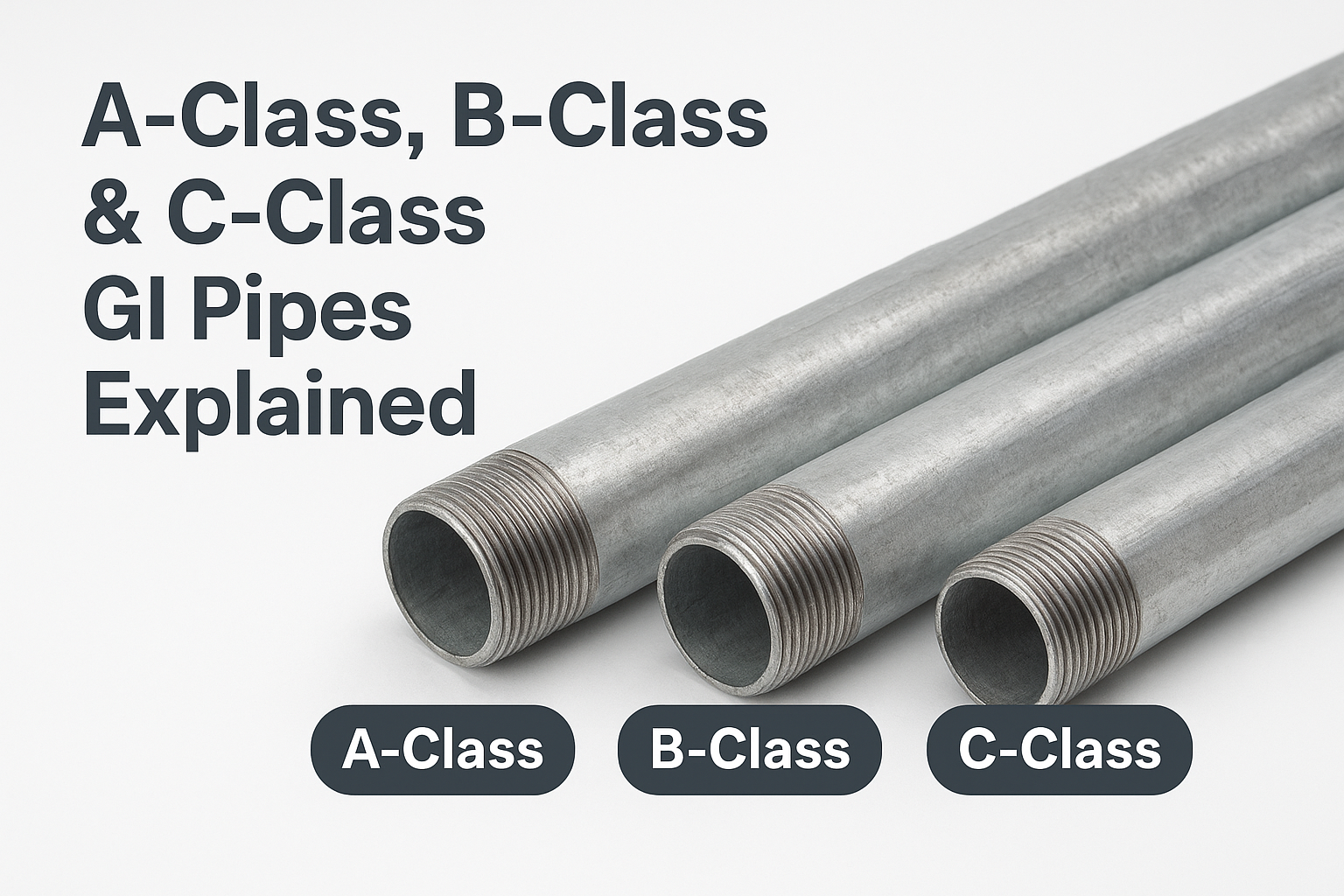
A-Class, B-Class & C-Class GI Pipes Explained is a practical guide for buyers, contractors, and engineers to understand how GI pipe classes differ in thickness, strength, pressure handling, and applications. Choosing the correct class directly impacts durability, safety, cost, and long-term performance of plumbing, construction, agricultural, and industrial projects. This guide helps buyers make informed decisions based on real project needs rather than price alone.
Contents
- 1 TL;DR – Key Takeaways
- 2 Introduction
- 3 What Are GI Pipes?
- 4 Why GI Pipe Classification Matters
- 5 Basis of GI Pipe Classification
- 6 Overview of A-Class GI Pipes
- 7 Overview of B-Class GI Pipes
- 8 Overview of C-Class GI Pipes
- 9 How Buyers Typically Get It Wrong
- 10 Factors Buyers Must Consider Before Choosing a GI Pipe Class
- 11 Thickness, Weight & Pressure Capacity Differences
- 12 Comparison Table: A-Class, B-Class & C-Class GI Pipes
- 13 Applications Based on Real Project Needs
- 14 A-Class GI Pipes: Where They Fit Best
- 15 B-Class GI Pipes: The Most Versatile Option
- 16 C-Class GI Pipes: High-Pressure Specialists
- 17 Structural Strength and Load-Bearing Capacity
- 18 Lifespan Expectations Across Pipe Classes
- 19 How Improper Selection Affects Projects
- 20 Industry Standards and Compliance
- 21 Cost vs Performance: Making the Right Buying Decision
- 22 Selecting the Right GI Pipe Class by Industry
- 23 Common Buyer Mistakes to Avoid
- 24 Inspection Checklist Before Purchase
- 25 Environmental and Corrosion Considerations
- 26 Longevity vs One-Time Cost
- 27 Quick Decision Guide: Which GI Pipe Should You Buy?
- 28 Why Contractors Prefer Higher-Class GI Pipes
- 29 Role of Standards and Certification
- 30 Long-Term Project Cost Analysis
- 31 Key Takeaways for Buyers and Engineers
- 32 Conclusion
- 33 FAQs:
TL;DR – Key Takeaways
- A-Class GI pipes are best for low-pressure and light-duty use
- B-Class GI pipes suit medium-pressure commercial and construction needs
- C-Class GI pipes are designed for high-pressure and heavy-duty applications
- Pipe class affects pipe thickness, strength, lifespan, and cost
- Selecting the wrong class can lead to leaks, failures, and higher maintenance
- Understanding A-Class, B-Class & C-Class GI Pipes Explained helps buyers avoid costly mistakes
Introduction
A-Class, B-Class & C-Class GI Pipes Explained becomes essential when buyers face confusion while selecting the right GI pipe for plumbing, construction, agriculture, or industrial use. Many projects fail or incur unnecessary costs because the pipe class does not match pressure, load, or environmental conditions.
GI pipes may look similar from the outside, but their thickness, weight, and performance differ significantly across classes. These differences determine how safely and efficiently a pipe will perform over time. Understanding pipe classification allows buyers to align material selection with application requirements, compliance standards, and long-term reliability.
This blog explains GI pipe classes in simple terms, breaks down where each class fits best, and helps buyers confidently select the right option for their project.
What Are GI Pipes?
GI pipes, or Galvanized Iron pipes, are steel pipes coated with zinc to protect against corrosion. The galvanization process creates a barrier between the steel surface and environmental elements such as water, air, and soil moisture. This protection makes GI pipes suitable for outdoor, underground, and water-based applications.
GI pipes are widely used because they offer:
- Good corrosion resistance
- Long lifespan
- Structural strength
- Cost efficiency compared to stainless steel
However, not every GI pipe is meant for every job. This is where understanding A-Class, B-Class & C-Class GI Pipes Explained becomes critical for buyers.
Why GI Pipe Classification Matters
GI pipe classification is based on wall thickness and weight. These factors determine how much pressure the pipe can handle and how durable it will be under different working conditions.
Choosing the wrong class can result in:
- Internal leaks due to pressure mismatch
- Pipe deformation or collapse
- Shorter service life
- Increased repair and replacement costs
A-Class, B-Class & C-Class GI Pipes Explained helps buyers avoid overengineering or underengineering their systems.
Basis of GI Pipe Classification
GI pipes are classified into three main categories:
- A-Class (Light)
- B-Class (Medium)
- C-Class (Heavy)
Each class is designed to serve specific functional requirements. The classification primarily depends on:
- Wall thickness
- Weight per meter
- Pressure-bearing capacity
- Intended application
These standards are usually aligned with BIS specifications used across India.
Overview of A-Class GI Pipes
A-Class GI pipes are light-duty pipes used mainly in low-pressure environments. They are thinner and lighter compared to other classes, making them easier to handle and install.
Key Characteristics of A-Class GI Pipes
- Thinner wall thickness
- Lightweight structure
- Lower pressure tolerance
- Economical pricing
Common Applications
- Domestic water supply
- Temporary plumbing lines
- Light structural frameworks
- Drainage lines with low flow pressure
Limitations
While A-Class GI pipes are cost-effective, they are not suitable for high-pressure or heavy-load applications. Using them outside their recommended scope can significantly reduce performance and safety.
Understanding A-Class, B-Class & C-Class GI Pipes Explained helps buyers recognize that A-Class pipes serve a specific purpose rather than being a universal solution.
Overview of B-Class GI Pipes
B-Class GI pipes are medium-duty pipes and are among the most commonly used across residential, commercial, and construction projects.
Key Characteristics of B-Class GI Pipes
- Medium wall thickness
- Balanced strength-to-weight ratio
- Good pressure handling capacity
- Widely accepted across industries
Common Applications
- Building plumbing systems
- Construction scaffolding
- Irrigation pipelines
- Borewell connections
- Commercial water distribution
B-Class pipes offer a balance between cost and performance, which is why they dominate many mid-scale projects.
Overview of C-Class GI Pipes
C-Class GI pipes are heavy-duty pipes built for high-pressure and critical applications. They have the highest wall thickness among all GI pipe classes.
Key Characteristics of C-Class GI Pipes
- Thick walls
- Higher weight per meter
- Maximum pressure tolerance
- High structural strength
Common Applications
- Firefighting systems
- Industrial pipelines
- High-rise plumbing
- Heavy structural frameworks
- Municipal water supply lines
In applications where failure is not an option, C-Class GI pipes are the preferred choice. A-Class, B-Class & C-Class GI Pipes Explained clearly shows why higher class pipes are essential for safety-critical installations.
How Buyers Typically Get It Wrong
Many buyers select GI pipes solely based on price without understanding class differences. Common mistakes include:
- Using A-Class pipes in high-rise plumbing
- Choosing B-Class pipes for firefighting systems
- Overusing C-Class pipes where they are not needed
These decisions lead to either performance issues or unnecessary cost escalation.
Factors Buyers Must Consider Before Choosing a GI Pipe Class
Before exploring deeper applications in the next sections, buyers should evaluate:
- Operating pressure
- Installation environment
- Load and stress conditions
- Exposure to moisture or chemicals
- Lifespan expectations
- Compliance requirements
Understanding A-Class, B-Class & C-Class GI Pipes Explained equips buyers to match pipe selection with real-world demands instead of assumptions.
Thickness, Weight & Pressure Capacity Differences
Understanding A-Class, B-Class & C-Class GI Pipes Explained becomes much clearer when buyers compare thickness, weight, and pressure-handling ability. These factors directly decide where each pipe class can be safely used.
GI pipe thickness increases from A-Class to C-Class. As thickness increases, weight per meter also increases, allowing the pipe to withstand higher internal pressure and external loads.
Practical Meaning for Buyers
- Thicker pipes = higher pressure tolerance
- Heavier pipes = better structural strength
- Higher class = longer service life in demanding conditions
Choosing a thinner pipe for a high-pressure system may reduce upfront cost but increases long-term risk.
Comparison Table: A-Class, B-Class & C-Class GI Pipes
| Parameter | A-Class GI Pipes | B-Class GI Pipes | C-Class GI Pipes |
|---|---|---|---|
| Wall Thickness | Thin | Medium | Thick |
| Weight | Light | Moderate | Heavy |
| Pressure Handling | Low | Medium | High |
| Durability | Basic | Good | Excellent |
| Cost | Lowest | Moderate | Highest |
| Best Suited For | Domestic & low pressure | Commercial & construction | Industrial & safety systems |
This table reinforces why A-Class, B-Class & C-Class GI Pipes Explained is essential before placing any bulk order.
Applications Based on Real Project Needs
Instead of choosing based on category names alone, buyers should align GI pipe class with practical working conditions.
A-Class GI Pipes: Where They Fit Best
A-Class GI pipes perform well when pressure levels are low and structural stress is minimal.
Suitable Applications
- Domestic water lines
- Low-rise residential plumbing
- Garden irrigation lines
- Temporary site piping
- Drainage lines with gravity flow
When to Avoid A-Class
- Firefighting systems
- Borewell risers
- Industrial pipelines
- Multi-storey buildings
In these cases, using A-Class pipes can cause premature leakage and failure.
B-Class GI Pipes: The Most Versatile Option
Among all categories discussed in A-Class, B-Class & C-Class GI Pipes Explained, B-Class GI pipes are the most widely used because they balance strength and cost.
Suitable Applications
- Commercial plumbing
- Building scaffolding
- Medium-pressure water supply
- Agriculture irrigation mains
- Borewell pipe connections
Why Contractors Prefer B-Class
- Adequate pressure handling
- Easier availability
- Better lifespan than A-Class
- Cost-efficient for large projects
C-Class GI Pipes: High-Pressure Specialists
C-Class GI pipes are used where safety, pressure control, and durability are critical.
Suitable Applications
- Fire hydrant systems
- Industrial fluid transfer
- High-rise buildings
- Heavy fabrication structures
- Municipal water supply networks
C-Class pipes significantly reduce failure risks in environments where pipe replacement is complex or expensive.
Structural Strength and Load-Bearing Capacity
Another critical difference highlighted in A-Class, B-Class & C-Class GI Pipes Explained is load-bearing ability.
- A-Class pipes handle minimal external load
- B-Class pipes support moderate scaffolding and framework load
- C-Class pipes are suitable for heavy structural and safety installations
For applications like scaffolding or pipe-supported structures, choosing the correct class is essential for worker safety.
Lifespan Expectations Across Pipe Classes
Pipe class has a direct impact on lifecycle cost.
- A-Class: Short to medium-term lifespan under low stress
- B-Class: Long-term performance in standard environments
- C-Class: Very long service life, even under pressure
Higher-class pipes may cost more initially but often reduce total ownership cost due to fewer repairs.
How Improper Selection Affects Projects
Misunderstanding A-Class, B-Class & C-Class GI Pipes Explained often leads to:
- Burst pipes
- Pressure losses
- Water contamination
- Project downtime
- Rework and replacement costs
These risks increase significantly in industrial and firefighting installations.
Industry Standards and Compliance
GI pipe classes are manufactured according to BIS specifications. Compliance ensures consistent thickness, coating quality, and performance reliability.
Buyers should always confirm:
- Class marking on pipes
- Manufacturer certification
- Test reports if required
- Supplier credibility
This protects projects from substandard materials.
Cost vs Performance: Making the Right Buying Decision
One of the biggest reasons people search for A-Class, B-Class & C-Class GI Pipes Explained is confusion around pricing. Many buyers assume all GI pipes perform similarly and choose purely based on cost, which often leads to expensive mistakes later.
The reality is simple: higher class pipes cost more because they offer higher thickness, pressure tolerance, and durability.
Cost Breakdown in Practical Terms
- A-Class GI Pipes: Lowest initial cost, higher risk under pressure
- B-Class GI Pipes: Balanced pricing with reliable performance
- C-Class GI Pipes: Higher upfront cost, lowest maintenance expense
In long-term projects, C-Class GI pipes can actually be more economical due to reduced replacement and repair needs.
Selecting the Right GI Pipe Class by Industry
Different industries have very specific requirements. Understanding A-Class, B-Class & C-Class GI Pipes Explained helps avoid under-specifying or over-specifying materials.
Construction & Real Estate Projects
For residential and commercial buildings:
- A-Class: Suitable only for low-rise residential plumbing
- B-Class: Ideal for apartments, offices, and commercial blocks
- C-Class: Best option for high-rise buildings and fire systems
Most developers prefer B-Class pipes for internal plumbing and C-Class for fire safety lines.
Industrial Applications
Industrial environments demand strength and consistency.
- B-Class: Moderate fluid transfer and structural use
- C-Class: Chemical lines, compressed air, and heavy-duty pipelines
A-Class pipes are generally avoided in industrial setups due to safety risks.
Agriculture & Irrigation
In agriculture, cost and coverage matter equally.
- A-Class: Temporary irrigation lines
- B-Class: Main irrigation pipelines
- C-Class: Long-distance or high-pressure water delivery
This is another area where A-Class, B-Class & C-Class GI Pipes Explained proves essential for correct planning.
Firefighting & Safety Systems
Fire systems have zero tolerance for pipe failure.
- Only C-Class GI pipes are recommended
- High thickness ensures pressure stability
- Long lifespan reduces maintenance disruptions
Fire safety compliance is one of the strongest reasons to choose C-Class pipes despite higher initial investment.
Common Buyer Mistakes to Avoid
Even experienced buyers can misunderstand GI pipe classifications.
Mistake 1: Choosing by Price Alone
Lower cost may mean lower thickness and failure under pressure.
Mistake 2: Ignoring Application Conditions
Pressure, temperature, and exposure all impact performance.
Mistake 3: Mixing Pipe Classes in One System
This can cause imbalance in pressure distribution.
Mistake 4: Buying from Unverified Suppliers
Non-certified pipes often fail to meet class specifications.
Understanding A-Class, B-Class & C-Class GI Pipes Explained protects buyers from these costly oversights.
Inspection Checklist Before Purchase
Before finalizing an order, buyers should always verify:
- Pipe class marking (A, B, or C)
- Wall thickness consistency
- Uniform galvanization coating
- BIS compliance stamp
- Manufacturer reputation
This checklist ensures the pipe class delivers the expected performance.
Environmental and Corrosion Considerations
Although all GI pipes have zinc coating, thickness plays a role in corrosion resistance.
- A-Class: Faster wear in humid or coastal areas
- B-Class: Moderate resistance with proper maintenance
- C-Class: Strong corrosion protection due to thickness
For coastal regions and industrial zones, C-Class pipes significantly outperform lower classes.
Longevity vs One-Time Cost
Projects designed for 15–25 years should prioritize durability over price.
- A-Class suits short-term installations
- B-Class supports long-term standard use
- C-Class is ideal for critical infrastructure
This perspective is central to A-Class, B-Class & C-Class GI Pipes Explained, especially for planners and engineers.
Quick Decision Guide: Which GI Pipe Should You Buy?
If you’ve read this far, A-Class, B-Class & C-Class GI Pipes Explained becomes much easier to apply in real-world buying decisions. Instead of overthinking specifications, use this practical decision logic.
Choose A-Class GI pipes if:
- The project is temporary or low-pressure
- Budget is extremely tight
- Usage duration is short-term
Choose B-Class GI pipes if:
- You need reliable performance at a reasonable cost
- The application involves plumbing or moderate-pressure flow
- The project is residential or light commercial
Choose C-Class GI pipes if:
- Safety, pressure, and durability are non-negotiable
- The project involves fire lines, industrial use, or high-rise buildings
- Long-term maintenance cost matters more than upfront pricing
This clarity is why A-Class, B-Class & C-Class GI Pipes Explained is essential reading before placing any bulk order.
Why Contractors Prefer Higher-Class GI Pipes
Experienced contractors rarely cut costs on pipe classification.
- Fewer leak complaints
- Lower project liability
- Better compliance with inspection standards
- Reduced post-handover maintenance
For them, C-Class GI pipes often become the default choice for critical lines, while B-Class remains the most commonly used all-round option.
Role of Standards and Certification
GI pipes should always meet Indian Standards to ensure safety and performance.
Certified pipes ensure:
- Accurate wall thickness
- Consistent zinc coating
- Controlled manufacturing processes
- Reliable pressure ratings
Understanding A-Class, B-Class & C-Class GI Pipes Explained is incomplete without verifying BIS compliance before purchase.
Long-Term Project Cost Analysis
Many buyers underestimate lifecycle costs.
- A-Class pipes may need replacement sooner
- B-Class pipes balance durability and affordability
- C-Class pipes minimize downtime, leaks, and failures
Over a 10–20 year period, higher-grade pipes often result in lower total expenditure.
Key Takeaways for Buyers and Engineers
Let’s simplify everything one last time.
- A-Class = light-duty, short-term use
- B-Class = balanced choice for most applications
- C-Class = heavy-duty, high-pressure, high-safety
With this framework, A-Class, B-Class & C-Class GI Pipes Explained becomes a tool, not just information.
Conclusion
Choosing the correct GI pipe class is not about spending more—it’s about spending smart. The right classification ensures safety, durability, and long-term value. Whether you’re working on a residential project or industrial infrastructure, understanding A-Class, B-Class & C-Class GI Pipes Explained helps prevent costly errors and ensures project succe
Planning to buy GI pipes for your next project?
Work with an experienced and certified pipe supplier who can guide you on pipe class, application suitability, and BIS compliance—so you get the right pipe, not just the cheapest one.
FAQs:
1. What is the main difference between A-Class, B-Class, and C-Class GI pipes?
The difference lies in wall thickness, pressure handling, and intended application.
2. Are A-Class GI pipes safe for residential use?
Yes, but only for low-pressure water lines and short-term applications.
3. Which GI pipe class is best for plumbing?
B-Class GI pipes are most commonly used for plumbing due to balanced strength and cost.
4. Can C-Class GI pipes be used for all applications?
Yes, but they may increase costs where lighter pipes would suffice.
5. Why are C-Class GI pipes more expensive?
They have thicker walls, handle higher pressure, and last longer.
6. Are B-Class GI pipes suitable for industrial use?
They can be used for moderate industrial applications, but C-Class is safer for heavy duty.
7. How do I identify the class of a GI pipe?
Pipe class is usually marked on the surface along with size and standard.
8. Can different pipe classes be mixed in one system?
Not recommended, as it can cause pressure imbalance and failures.
9. Do all GI pipes have corrosion resistance?
Yes, but thicker pipes offer better long-term corrosion resistance.
10. Which GI pipe class has the longest lifespan?
C-Class GI pipes have the longest lifespan under demanding conditions.