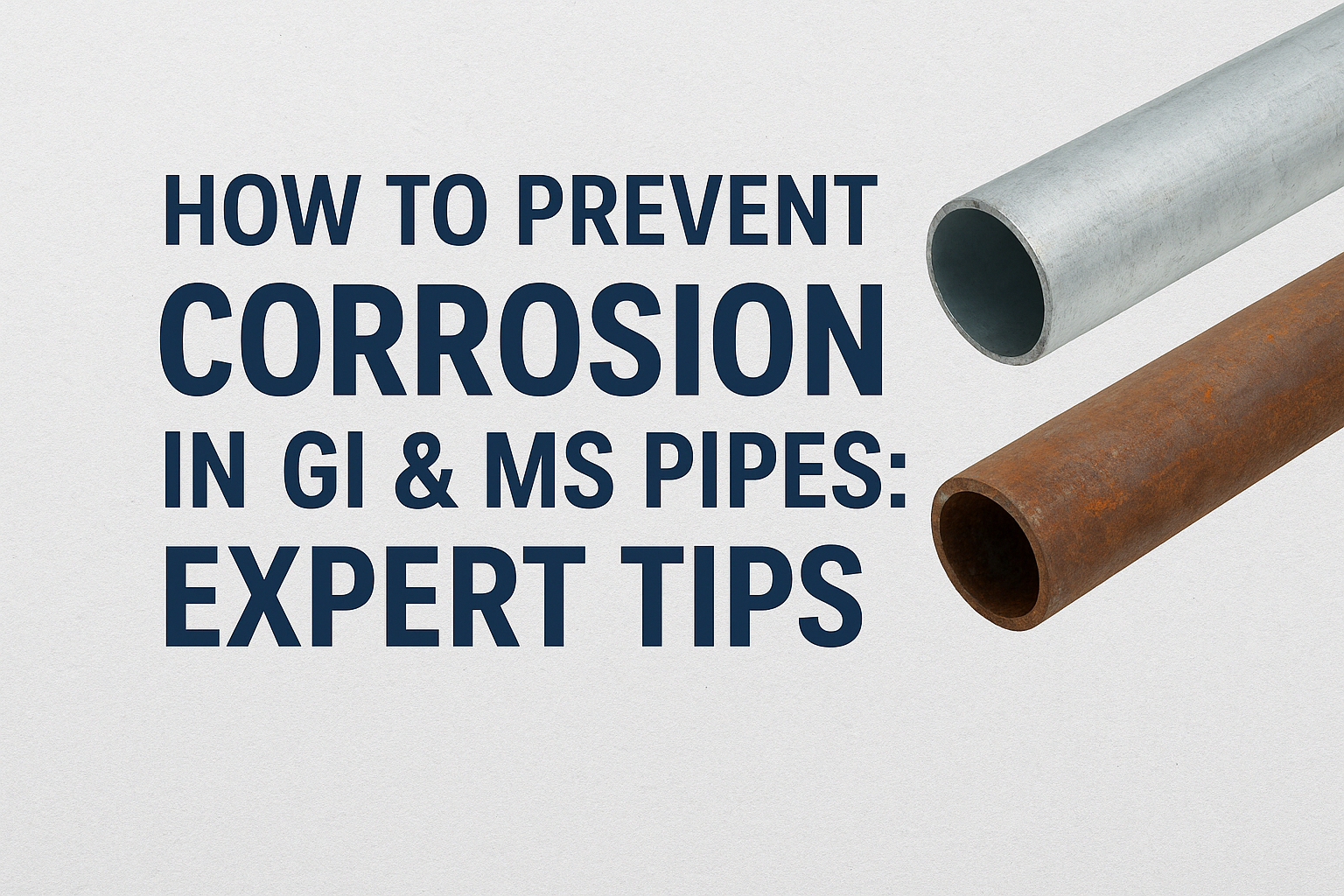
Understanding How to Prevent Corrosion in GI & MS Pipes: Expert Tips is critical for builders, engineers, and contractors aiming for long-lasting infrastructure. Corrosion weakens pipes, increases leakage risk, and leads to costly replacements. While GI pipes offer built-in corrosion resistance through galvanization, MS pipes require additional protective measures. This guide explains proven methods to control corrosion, from material selection and coatings to storage and maintenance, helping projects achieve durability, safety, and cost efficiency.
Contents
- 1 TL;DR
- 2 Introduction: Why Corrosion Control Matters
- 3 Understanding Corrosion in GI & MS Pipes
- 4 Key Factors That Accelerate Corrosion
- 5 Why Prevention Is Better Than Repair
- 6 Role of Standards in Corrosion Control
- 7 Understanding Corrosion in GI & MS Pipes: Why It Happens
- 8 Choosing the Right Pipe for the Right Environment
- 9 Surface Protection Methods to Prevent Corrosion
- 10 Importance of Proper Installation Practices
- 11 Environmental Control and Exposure Management
- 12 Storage and Handling Before Installation
- 13 Why Preventive Maintenance Matters
- 14 Advanced Coating Solutions for Corrosion Prevention
- 15 Cathodic Protection: Industrial-Grade Corrosion Control
- 16 Environmental Factors That Accelerate Corrosion
- 17 Proper Drainage and Moisture Control
- 18 Welding and Joint Protection
- 19 Storage Practices That Prevent Early Corrosion
- 20 Regular Inspection and Preventive Maintenance
- 21 Choosing the Right Pipe for the Right Application
- 22 Role of Quality Manufacturing and Standards
- 23 Conclusion
TL;DR
- Corrosion is the biggest reason GI & MS pipes fail prematurely
- Proper material selection, coatings, and installation reduce rust risks
- GI pipes resist corrosion better due to zinc coating; MS pipes need protection
- Storage, handling, and maintenance play a major role
- Following expert-recommended practices significantly extends pipe life
Before reading this article have a quick read on The Difference Between GI and MS pipes.
Introduction: Why Corrosion Control Matters
Corrosion is one of the most common yet underestimated problems in piping systems. Whether used in water supply, construction frameworks, industrial plants, or fire safety networks, GI and MS pipes are constantly exposed to moisture, air, chemicals, and varying temperatures. Without proper protection, corrosion can reduce pipe thickness, compromise structural integrity, and cause unexpected failures.
This is why How to Prevent Corrosion in GI & MS Pipes: Expert Tips is not just a maintenance topic—it is a project planning necessity. Corrosion-related failures often result in downtime, safety hazards, and expensive repairs that far exceed the cost of preventive measures.
Understanding corrosion behavior in both GI and MS pipes helps stakeholders make informed decisions at every stage, from procurement to installation and long-term use.
Understanding Corrosion in GI & MS Pipes
What Is Corrosion?
Corrosion is a natural electrochemical process where metal reacts with oxygen, moisture, or chemicals, leading to material degradation. In steel pipes, this usually appears as rust, pitting, or surface scaling.
In the context of How to Prevent Corrosion in GI & MS Pipes: Expert Tips, recognizing how corrosion starts is the first step toward stopping it.
Corrosion Behavior in GI Pipes
GI (Galvanized Iron) pipes are mild steel pipes coated with zinc. The zinc layer acts as a sacrificial barrier, meaning it corrodes first and protects the steel beneath.
Key points:
- Zinc slows down oxidation
- Minor scratches self-heal through zinc oxidation
- Long lifespan in moist and outdoor environments
However, GI pipes are not corrosion-proof forever. Once the zinc layer wears off due to abrasion, poor handling, or aggressive water chemistry, rust can begin.
This is why How to Prevent Corrosion in GI & MS Pipes: Expert Tips emphasizes proper handling and installation even for galvanized products.
Corrosion Behavior in MS Pipes
MS (Mild Steel) pipes have no inherent corrosion-resistant coating. They are highly prone to rust when exposed to moisture, humidity, or chemicals.
Common corrosion risks for MS pipes:
- Outdoor exposure without paint
- Condensation inside pipes
- Chemical or saline environments
- Poor drainage or water stagnation
Because of this vulnerability, How to Prevent Corrosion in GI & MS Pipes: Expert Tips places strong emphasis on coatings, paints, and controlled environments for MS pipes.
Key Factors That Accelerate Corrosion
Understanding what accelerates corrosion helps prevent it more effectively.
Environmental Exposure
- High humidity
- Coastal or saline air
- Industrial pollution
- Underground moisture
Water Quality
- High chloride content
- Acidic or alkaline water
- Dissolved oxygen levels
Mechanical Damage
- Scratches on GI zinc coating
- Improper handling during transport
- Poor stacking at site
Installation Errors
- Water stagnation points
- Improper slope
- Inadequate drainage
Every expert discussion on How to Prevent Corrosion in GI & MS Pipes: Expert Tips highlights that corrosion is rarely caused by one factor alone—it’s usually a combination.
Why Prevention Is Better Than Repair
Repairing corroded pipes is expensive and disruptive. Prevention, on the other hand, is predictable and cost-effective.
Benefits of corrosion prevention:
- Extended service life
- Reduced maintenance costs
- Improved system safety
- Better water quality
- Compliance with standards
Projects that apply How to Prevent Corrosion in GI & MS Pipes: Expert Tips from the planning stage consistently outperform those that rely on reactive maintenance.
Role of Standards in Corrosion Control
Indian Standards play a major role in corrosion prevention:
- IS 1239 – Defines material quality and thickness
- IS 3589 – Covers pipes for water and gas
- IS 1161 – Structural steel tubes
- IS 4923 – Square and rectangular hollow sections
Pipes manufactured and supplied as per BIS standards already meet minimum corrosion-resistance benchmarks. However, standards alone are not enough—correct usage and protection methods are equally important, as outlined in How to Prevent Corrosion in GI & MS Pipes: Expert Tips.
Understanding Corrosion in GI & MS Pipes: Why It Happens
To apply the right strategies in How to Prevent Corrosion in GI & MS Pipes: Expert Tips, it is essential to understand why corrosion occurs in the first place. Corrosion is a natural electrochemical reaction where metal deteriorates due to exposure to moisture, oxygen, chemicals, or salts. However, the causes and severity differ between GI pipes and MS pipes.
Corrosion Behavior in GI Pipes
GI pipes are protected by a zinc coating applied through galvanization. This zinc layer acts as a sacrificial barrier, meaning it corrodes first to protect the steel underneath. While this significantly delays rusting, corrosion can still occur due to:
- Damage or scratches on the zinc coating
- Long-term exposure to acidic or alkaline water
- Industrial chemicals or polluted environments
- Coastal or high-humidity locations
Understanding these factors is crucial when applying How to Prevent Corrosion in GI & MS Pipes: Expert Tips in plumbing, firefighting, and outdoor piping systems.
Corrosion Behavior in MS Pipes
MS pipes lack a protective coating by default, making them more vulnerable to corrosion. Rust formation can begin quickly if MS pipes are exposed to moisture, air, or corrosive substances. Common causes include:
- Outdoor exposure without paint or coating
- Condensation in closed industrial systems
- Chemical or saline environments
- Poor storage and handling
This is why How to Prevent Corrosion in GI & MS Pipes: Expert Tips places strong emphasis on surface protection and environmental control for MS pipes.
Choosing the Right Pipe for the Right Environment
One of the most effective principles in How to Prevent Corrosion in GI & MS Pipes: Expert Tips is correct pipe selection based on usage conditions. Many corrosion problems arise simply because the wrong pipe type is used for a specific environment.
When GI Pipes Are the Better Choice
GI pipes are best suited for environments where moisture exposure is unavoidable. They perform well in:
- Water supply and plumbing lines
- Firefighting systems
- Outdoor pipelines and fencing
- Agricultural irrigation systems
The zinc coating provides built-in corrosion resistance, making GI pipes a long-term solution when moisture and humidity are constant factors.
When MS Pipes Are More Suitable
MS pipes are ideal where strength and fabrication flexibility are required, and corrosion exposure is limited or controlled. Typical applications include:
- Structural frameworks
- Industrial machinery supports
- Indoor pipelines
- Fabrication and welding projects
In these cases, How to Prevent Corrosion in GI & MS Pipes: Expert Tips focuses on coatings, paints, and controlled environments rather than inherent material protection.
Surface Protection Methods to Prevent Corrosion
Surface protection is one of the most critical sections in How to Prevent Corrosion in GI & MS Pipes: Expert Tips, especially for MS pipes.
Protective Coatings for MS Pipes
Applying the right coating significantly slows down corrosion. Common protective solutions include:
- Anti-corrosion primers
- Epoxy coatings
- Bitumen or tar-based coatings
- Powder coating for industrial use
These coatings form a barrier that prevents moisture and oxygen from reacting with the steel surface.
Maintaining the Zinc Coating on GI Pipes
Although GI pipes already have a zinc layer, proper care is still required. Key measures include:
- Avoiding abrasive handling that damages coating
- Preventing prolonged contact with acidic substances
- Using proper fittings to reduce mechanical damage
These practices directly align with How to Prevent Corrosion in GI & MS Pipes: Expert Tips for extending service life.
Importance of Proper Installation Practices
Incorrect installation is a hidden but major contributor to corrosion. One overlooked aspect in How to Prevent Corrosion in GI & MS Pipes: Expert Tips is installation quality.
Installation Tips for GI Pipes
- Use threaded connections instead of welding where possible
- If welding is required, ensure proper ventilation and post-weld coating
- Seal joints to prevent water ingress
Installation Tips for MS Pipes
- Apply primer or paint immediately after fabrication
- Avoid leaving bare steel exposed after cutting or welding
- Ensure proper slope in pipelines to avoid water stagnation
Correct installation minimizes weak points where corrosion usually begins.
Environmental Control and Exposure Management
Environmental exposure plays a decisive role in corrosion. A key takeaway from How to Prevent Corrosion in GI & MS Pipes: Expert Tips is controlling the surrounding environment wherever possible.
Indoor Applications
- Maintain proper ventilation
- Control humidity levels
- Avoid chemical vapors near exposed pipes
Outdoor Applications
- Use weather-resistant coatings
- Avoid direct soil contact without insulation
- Protect pipes from standing water
Managing exposure conditions significantly enhances pipe durability.
Storage and Handling Before Installation
Corrosion can start even before pipes are installed. This makes storage practices an important part of How to Prevent Corrosion in GI & MS Pipes: Expert Tips.
- Store pipes on raised platforms
- Keep them covered from rain and moisture
- Avoid stacking methods that cause scratches
- Rotate stock to prevent long-term exposure
Proper storage ensures pipes remain corrosion-free until installation.
Why Preventive Maintenance Matters
Preventive maintenance is often overlooked but is central to How to Prevent Corrosion in GI & MS Pipes: Expert Tips. Regular inspections allow early detection of corrosion signs such as:
- Surface discoloration
- Peeling paint or coating
- Rust spots or pitting
Early intervention reduces repair costs and extends system life.
Advanced Coating Solutions for Corrosion Prevention
One of the most effective answers to How to Prevent Corrosion in GI & MS Pipes: Expert Tips lies in choosing the right protective coating based on exposure conditions.
Hot-Dip Galvanizing (For GI Pipes)
Hot-dip galvanizing remains the most reliable corrosion-prevention method for GI pipes.
Benefits include:
- Uniform zinc coating thickness
- Long-term protection even in outdoor environments
- Self-healing protection when minor scratches occur
This process significantly delays oxidation and is ideal for water supply, irrigation, and external installations.
Epoxy and Fusion-Bonded Coatings
Epoxy coatings are widely used in industrial and underground applications.
Advantages:
- Strong chemical resistance
- Excellent adhesion to MS pipes
- Suitable for aggressive environments
Epoxy-lined pipes are often chosen where How to Prevent Corrosion in GI & MS Pipes: Expert Tips becomes critical for chemical plants and wastewater projects.
Cathodic Protection: Industrial-Grade Corrosion Control
Cathodic protection is one of the most advanced methods included in How to Prevent Corrosion in GI & MS Pipes: Expert Tips.
How It Works
- Uses sacrificial anodes or impressed current systems
- Redirects corrosion activity away from the pipe surface
- Common in underground and submerged pipelines
This method is frequently used in oil & gas pipelines, marine installations, and long-distance water lines.
Environmental Factors That Accelerate Corrosion
Understanding environmental exposure is essential when applying How to Prevent Corrosion in GI & MS Pipes: Expert Tips.
Key environmental risks:
- High humidity
- Coastal salt exposure
- Acidic soil conditions
- Industrial pollutants
- Standing water accumulation
GI pipes perform better in wet environments, while MS pipes require additional protection in such conditions.
Proper Drainage and Moisture Control
Water retention accelerates corrosion more than direct exposure.
Best practices include:
- Avoid horizontal pipe installation where water can settle
- Ensure proper slope in pipelines
- Install drainage points in structural frameworks
- Prevent soil-to-metal contact using spacers
These steps reinforce How to Prevent Corrosion in GI & MS Pipes: Expert Tips at the installation stage itself.
Welding and Joint Protection
Welded areas are the most vulnerable points for corrosion.
To protect joints:
- Apply zinc-rich paint on GI pipe welds
- Use epoxy or primer coatings on MS pipe joints
- Inspect weld quality before coating
- Seal threaded joints properly
Ignoring joint protection undermines How to Prevent Corrosion in GI & MS Pipes: Expert Tips even if the rest of the pipe is well protected.
Storage Practices That Prevent Early Corrosion
Corrosion often begins before installation.
Recommended storage methods:
- Store pipes on raised platforms
- Keep away from direct soil contact
- Cover pipes but allow airflow
- Separate GI and MS pipes
- Avoid water accumulation between stacked pipes
Correct storage is a practical but often overlooked part of How to Prevent Corrosion in GI & MS Pipes: Expert Tips.
Regular Inspection and Preventive Maintenance
Preventive maintenance extends pipe life significantly.
Inspection checklist:
- Surface rust spots
- Coating damage
- Moisture traps
- Joint integrity
- Paint peeling or blistering
Scheduled inspections ensure How to Prevent Corrosion in GI & MS Pipes: Expert Tips is followed throughout the pipe’s lifecycle, not just during installation.
Choosing the Right Pipe for the Right Application
One of the most effective corrosion-prevention strategies is correct pipe selection.
General guidance:
- Use GI pipes for water, outdoor, and humid environments
- Use MS pipes for indoor, dry, and structural applications
- Avoid mixing pipe types without proper isolation
Correct selection strengthens the foundation of How to Prevent Corrosion in GI & MS Pipes: Expert Tips before any protective method is applied.
Role of Quality Manufacturing and Standards
Pipes manufactured as per BIS standards resist corrosion better due to:
- Controlled chemical composition
- Uniform thickness
- Proper surface finish
This reinforces why sourcing from certified suppliers is critical when implementing How to Prevent Corrosion in GI & MS Pipes: Expert Tips.
Monitoring and Inspection Practices for Corrosion Control
An often-overlooked aspect of How to Prevent Corrosion in GI & MS Pipes: Expert Tips is regular monitoring. Even the best coatings and materials can degrade if early warning signs are ignored.
Effective inspection practices include:
- Visual inspection for rust spots, flaking, or discoloration
- Checking joints, welds, and bends where corrosion starts first
- Monitoring areas exposed to moisture, chemicals, or temperature changes
- Periodic thickness measurement in critical pipelines
- Recording corrosion patterns for preventive planning
For GI pipes, inspections should focus on zinc coating integrity. For MS pipes, surface rust detection and coating condition are critical. Regular monitoring ensures corrective action before structural damage occurs.
Environmental Control to Reduce Corrosion Risk
Environmental exposure plays a major role in corrosion. One of the most practical insights from How to Prevent Corrosion in GI & MS Pipes: Expert Tips is controlling the surrounding environment wherever possible.
Key environmental controls include:
- Avoiding water stagnation near pipe surfaces
- Ensuring proper drainage around underground pipelines
- Using insulation to prevent condensation on indoor pipes
- Avoiding direct contact with dissimilar metals
- Protecting pipes from chemical vapors and fumes
In industrial settings, isolating pipes from corrosive atmospheres significantly extends service life and reduces maintenance costs.
Proper Storage and Handling to Prevent Early Corrosion
Corrosion often begins even before installation. A critical lesson from How to Prevent Corrosion in GI & MS Pipes: Expert Tips is that improper storage can compromise pipe quality early.
Best practices include:
- Storing pipes on raised platforms, not directly on soil
- Using covered sheds to protect from rain and humidity
- Ensuring air circulation between stacked pipes
- Avoiding contact with chemicals, fertilizers, or salt
- Preventing scratches or damage to GI zinc coating
Correct storage protects both GI and MS pipes from premature rusting and coating damage.
Importance of Choosing the Right Pipe Distributor
One of the strongest recommendations in How to Prevent Corrosion in GI & MS Pipes: Expert Tips is sourcing pipes from a reliable distributor. Quality manufacturing and proper handling begin at the supply stage.
A trusted distributor ensures:
- BIS-compliant GI and MS pipes
- Uniform zinc coating thickness in GI pipes
- Consistent steel quality in MS pipes
- Proper storage before dispatch
- Correct guidance on coatings and applications
Poor-quality pipes corrode faster regardless of maintenance, making supplier selection critical.
Long-Term Cost Benefits of Corrosion Prevention
Preventing corrosion is not an expense—it is an investment. Projects that follow How to Prevent Corrosion in GI & MS Pipes: Expert Tips experience:
- Lower maintenance costs
- Fewer replacements and shutdowns
- Improved safety and compliance
- Longer pipe lifespan
- Better project ROI
Spending slightly more on coatings, inspections, and quality materials results in significant long-term savings.
Conclusion
Understanding How to Prevent Corrosion in GI & MS Pipes: Expert Tips is essential for ensuring durability, safety, and cost efficiency in any project. By selecting the right pipe material, applying proper coatings, maintaining correct storage, and following regular inspection practices, corrosion risks can be significantly reduced. The foundation of corrosion prevention begins with quality pipes sourced from a reliable distributor.
For corrosion-resistant, BIS-certified GI and MS pipes backed by expert guidance, connect with a trusted pipe distributor today and secure long-lasting performance for your project.