
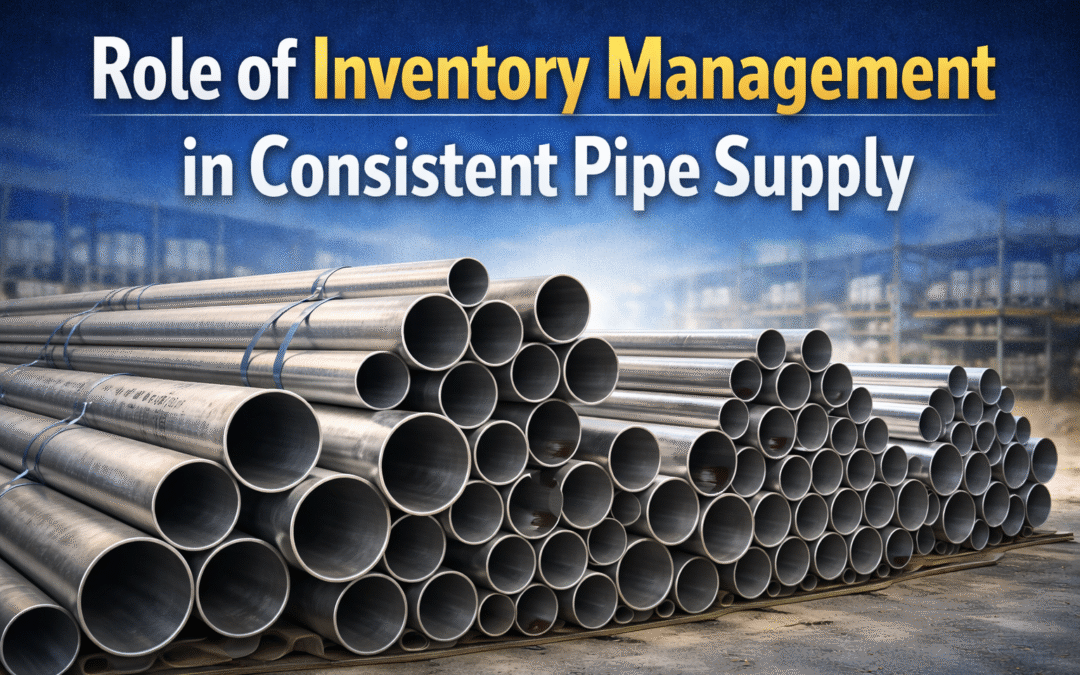
The Role of Inventory Management in Consistent Pipe Supply is critical for pipe distributors, contractors, and infrastructure projects that depend on uninterrupted material availability. Proper inventory planning ensures steady supply, prevents project delays, controls costs, and maintains quality consistency. This blog explains how structured inventory systems support reliable GI and MS pipe availability, especially for large-scale construction and industrial projects.
Contents
- 1 TL;DR
- 2 Introduction: Why Inventory Determines Pipe Availability
- 3 Understanding Inventory Management in Pipe Distribution
- 4 Why Consistent Pipe Availability Matters to Projects
- 5 Types of Pipes That Require Strong Inventory Planning
- 6 Demand Forecasting and Its Role in Pipe Availability
- 7 Inventory Depth vs Inventory Spread
- 8 Warehouse Management and Pipe Handling
- 9 Inventory and Quality Consistency
- 10 Inventory as a Competitive Advantage
- 11 Inventory Systems That Support Consistent Pipe Supply
- 12 Importance of Stock Segmentation by Application
- 13 Managing Bulk Orders Without Disrupting Regular Supply
- 14 Preventing Stockouts Through Reorder Planning
- 15 Avoiding Overstock and Dead Inventory
- 16 Inventory Rotation and Pipe Quality Preservation
- 17 Coordination Between Inventory and Logistics
- 18 Inventory Visibility for Customers
- 19 Supporting Long-Term Projects Through Inventory Commitment
- 20 Inventory Management as Risk Control
- 21 Inventory Planning for GI Pipes vs MS Pipes
- 22 Managing Seasonal Demand Fluctuations
- 23 Inventory Accuracy and Specification Control
- 24 Reducing Dependence on Emergency Procurement
- 25 Inventory and Price Stability
- 26 Handling Multiple Project Timelines Simultaneously
- 27 Inventory as a Measure of Distributor Credibility
- 28 Supporting Large Orders Without Compromising Quality
- 29 Inventory Audits and Continuous Improvement
- 30 Preparing Inventory for Long-Term Market Growth
- 31 Common Inventory Challenges Faced by Pipe Distributors
- 32 How Strong Inventory Systems Improve Customer Trust
- 33 Inventory Management as a Competitive Advantage
- 34 Long-Term Impact on Project Execution
- 35 Why Inventory Discipline Matters More Than Ever
- 36 Conclusion
- 37 FAQs
- 37.1 1. Why is inventory management important in pipe distribution?
- 37.2 2. How does inventory planning prevent project delays?
- 37.3 3. Does inventory management affect pipe pricing?
- 37.4 4. How does inventory accuracy impact construction projects?
- 37.5 5. What happens when inventory is poorly managed?
- 37.6 6. How does inventory management build customer trust?
- 37.7 7. Is inventory management important for bulk orders?
- 37.8 8. How often should pipe inventory be audited?
- 37.9 9. Can inventory planning support multiple projects at once?
- 37.10 10. Who benefits most from strong inventory management?
TL;DR
- The Role of Inventory Management in Consistent Pipe Supply directly impacts project timelines
- Poor inventory planning causes shortages, delays, and price instability
- Strong inventory systems ensure continuous GI and MS pipe availability
- Distributors like Khandelwal Pipe Syndicate rely on inventory discipline for reliability
- Inventory control improves quality consistency and customer trust
- Long-term projects depend on predictable pipe supply backed by stock readiness
Introduction: Why Inventory Determines Pipe Availability
In construction, infrastructure, and industrial projects, material availability often determines success or failure. Even with skilled labor and approved designs, a project can stall if pipes are unavailable at the right time. This is where the Role of Inventory Management in Consistent Pipe Supply becomes essential.
Pipe distribution is not just about selling GI and MS pipes. It is about anticipating demand, stocking the right sizes and grades, and ensuring smooth movement from warehouse to site. Distributors who fail at inventory planning often face stockouts, rushed sourcing, and quality mismatches—problems that ripple across entire project timelines.
For contractors and engineers, consistent pipe availability is not optional. Fire safety lines, plumbing networks, structural frameworks, and industrial pipelines all depend on timely pipe supply. A single missing size or thickness can delay installations and increase costs.
This is why experienced distributors like Khandelwal Pipe Syndicate focus heavily on inventory planning. Their operations highlight how the Role of Inventory Management in Consistent Pipe Supply goes far beyond storage—it directly supports reliability, trust, and long-term partnerships.
Understanding Inventory Management in Pipe Distribution
Inventory management in pipe distribution involves planning, stocking, tracking, and replenishing GI and MS pipes across multiple sizes, thicknesses, and grades. Unlike fast-moving consumer goods, pipes are bulky, heavy, and application-specific. Poor inventory decisions lead to blocked capital or critical shortages.
The Role of Inventory Management in Consistent Pipe Supply begins with understanding demand patterns. Residential plumbing, commercial construction, fire-fighting systems, and industrial fabrication all require different pipe specifications. Stocking randomly or reacting only after orders arrive creates gaps in availability.
A structured inventory system ensures that:
- Fast-moving pipe sizes are always available
- Critical grades are stocked in adequate quantity
- Slow-moving inventory is controlled to avoid overstock
- Seasonal demand fluctuations are anticipated
Distributors who master the Role of Inventory Management in Consistent Pipe Supply do not depend on emergency sourcing.
Why Consistent Pipe Availability Matters to Projects
Pipe availability affects more than procurement schedules. It directly impacts labor planning, equipment usage, and project coordination.
When pipes are consistently available:
- Workflows remain uninterrupted
- Labor productivity stays high
- Installation quality remains consistent
- Budget overruns are reduced
When inventory fails:
- Sites face idle manpower
- Emergency purchases increase costs
- Quality compromises occur
- Project deadlines are missed
This is why the Role of Inventory Management in Consistent Pipe Supply is closely linked to overall project efficiency.
Large contractors prefer working with distributors who maintain ready stock rather than those who source only after receiving orders. Khandelwal Pipe Syndicate has built long-term relationships by ensuring that inventory availability supports real project timelines.
Types of Pipes That Require Strong Inventory Planning
Not all pipes move at the same pace. A key part of the Role of Inventory Management in Consistent Pipe Supply is understanding which products require deeper stock.
Common inventory categories include:
- GI pipes (light, medium, heavy class)
- MS black pipes for structural and industrial use
- Square and rectangular hollow sections
- Fire-fighting grade pipes
- Utility and plumbing-grade pipes
Each category has different turnover rates. For example, medium-class GI pipes may move faster in urban construction, while heavy MS pipes are critical for industrial projects.
Distributors who fail to balance these categories often face shortages in critical applications. Inventory planning ensures no single segment disrupts supply continuity.
Quick read on difference between GI & MS pipes.
Demand Forecasting and Its Role in Pipe Availability
Forecasting is the backbone of the Role of Inventory Management in Consistent Pipe Supply. Without demand forecasting, inventory decisions become reactive instead of proactive.
Effective forecasting considers:
- Historical sales data
- Ongoing project pipelines
- Seasonal construction cycles
- Government and infrastructure tenders
- Industrial expansion trends
By forecasting demand, distributors can stock pipes before demand peaks. This allows consistent supply even during high-demand periods.
Distributors like Khandelwal Pipe Syndicate use market understanding and project insights to align inventory with upcoming demand, reducing dependence on last-minute procurement.
Inventory Depth vs Inventory Spread
A common mistake in pipe distribution is stocking too many sizes in low quantities. The Role of Inventory Management in Consistent Pipe Supply requires balancing depth and spread.
Inventory depth ensures:
- Popular sizes are available in bulk
- Large orders can be fulfilled immediately
- Repeat clients receive uninterrupted supply
Inventory spread ensures:
- Multiple sizes and grades are available
- Diverse project needs are covered
Too much spread without depth leads to partial availability. Too much depth without spread limits flexibility. Successful inventory planning balances both.
Warehouse Management and Pipe Handling
Physical storage also affects the Role of Inventory Management in Consistent Pipe Supply. Poor warehousing leads to damage, corrosion, and misplacement.
Proper warehouse practices include:
- Size-wise stacking
- Grade-wise segregation
- FIFO (First In, First Out) movement
- Protection from moisture and impact
Damaged or misplaced pipes reduce usable inventory even if stock appears sufficient on paper. This is why warehouse discipline supports real availability, not just recorded stock.
Quicki reaad on How Storage & Handling Impact GI & MS Pipe Quality
Inventory and Quality Consistency
Inventory is not only about quantity. It is also about quality consistency. Mixing batches or grades can cause installation issues and rejections.
The Role of Inventory Management in Consistent Pipe Supply ensures:
- Uniform pipe thickness across batches
- Consistent coating quality for GI pipes
- Standardized specifications for repeat supply
This consistency is especially important for long-term projects supplied over several months.
Inventory as a Competitive Advantage
In pipe distribution, availability is often the deciding factor for clients. When two distributors offer similar pricing, the one with ready stock wins.
The Role of Inventory Management in Consistent Pipe Supply becomes a competitive advantage because:
- Clients trust predictable supply
- Emergency requirements are met
- Long-term contracts are secured
This is one reason established distributors invest heavily in inventory systems rather than operating on a hand-to-mouth model.
Inventory Systems That Support Consistent Pipe Supply
A strong inventory system is the operational backbone behind the Role of Inventory Management in Consistent Pipe Supply. Manual tracking or informal stock checks are no longer sufficient for pipe distributors handling multiple grades, diameters, and project timelines.
Modern inventory systems help distributors:
- Track real-time stock levels
- Monitor fast-moving and slow-moving pipe categories
- Allocate stock for ongoing projects
- Prevent double-selling or over-commitment
For GI and MS pipes, where sizes and thickness variations are critical, inventory systems reduce human error and improve order accuracy. This structured approach directly strengthens the Role of Inventory Management in Consistent Pipe Supply, especially during peak construction seasons.
Importance of Stock Segmentation by Application
Not all pipes serve the same purpose, and treating inventory as a single pool creates supply gaps. One key element of the Role of Inventory Management in Consistent Pipe Supply is segmenting stock based on application.
Common segmentation includes:
- Plumbing-grade pipes
- Structural and fabrication pipes
- Fire-fighting and safety pipes
- Industrial utility pipes
By segmenting inventory, distributors ensure that critical applications are never affected by unrelated demand spikes. For example, fire safety pipes should not be diverted to general construction during shortages.
Distributors like Khandelwal Pipe Syndicate maintain clear application-based inventory allocation, which supports uninterrupted supply across multiple project types and reinforces the Role of Inventory Management in Consistent Pipe Supply.
Managing Bulk Orders Without Disrupting Regular Supply
Large-scale projects often place bulk orders that can drain inventory if not planned carefully. One of the most practical challenges addressed by the Role of Inventory Management in Consistent Pipe Supply is balancing bulk demand with regular client requirements.
Effective inventory planning ensures:
- Bulk orders are planned against incoming stock
- Regular customers are not affected by large dispatches
- High-demand sizes are replenished in advance
Without this balance, distributors risk favoring one project at the cost of others. Inventory forecasting allows distributors to commit to bulk orders confidently while maintaining supply continuity.
Preventing Stockouts Through Reorder Planning
Stockouts are one of the biggest threats to the Role of Inventory Management in Consistent Pipe Supply. A stockout does not only mean lost sales—it disrupts projects, damages trust, and forces emergency sourcing.
Reorder planning helps prevent this by:
- Defining minimum stock levels for each pipe category
- Setting reorder points based on lead time
- Accounting for seasonal demand surges
GI and MS pipes often have manufacturer lead times. Distributors who reorder only after stock depletion face unavoidable gaps. Proper reorder planning ensures that stock arrives before shortages occur.
Avoiding Overstock and Dead Inventory
While shortages are harmful, overstocking is equally damaging. The Role of Inventory Management in Consistent Pipe Supply also involves controlling excess inventory that ties up capital and storage space.
Dead inventory issues arise when:
- Rare sizes are overstocked
- Demand patterns are misread
- Project-specific pipes are stocked without confirmed orders
Balanced inventory management ensures capital is invested in high-demand products while minimizing slow-moving stock. This financial discipline allows distributors to maintain consistent availability without increasing prices.
Inventory Rotation and Pipe Quality Preservation
Inventory rotation plays a direct role in quality preservation. The Role of Inventory Management in Consistent Pipe Supply includes ensuring older stock moves first to avoid deterioration.
Proper rotation practices include:
- FIFO (First In, First Out) movement
- Batch-wise identification
- Regular physical inspections
For GI pipes, prolonged storage without rotation can affect coating condition. For MS pipes, exposure and handling issues can impact surface quality. Rotation ensures that supplied pipes meet expected standards.
Coordination Between Inventory and Logistics
Inventory management cannot function in isolation. Its effectiveness depends on coordination with logistics and dispatch operations. This integration strengthens the Role of Inventory Management in Consistent Pipe Supply by ensuring stocked material moves efficiently to project sites.
Key coordination points include:
- Dispatch scheduling aligned with stock availability
- Partial dispatch planning for phased projects
- Transport allocation based on pipe size and weight
Without coordination, inventory may exist on paper but remain inaccessible due to poor logistics planning. Successful distributors align inventory readiness with dispatch execution.
Inventory Visibility for Customers
Transparency builds trust. The Role of Inventory Management in Consistent Pipe Supply increasingly includes giving customers visibility into stock availability.
This helps buyers:
- Plan procurement schedules
- Avoid last-minute changes
- Place advance orders confidently
Distributors who communicate stock status clearly strengthen long-term relationships. Clients value honesty over unrealistic commitments.
Supporting Long-Term Projects Through Inventory Commitment
Infrastructure and industrial projects often span months or years. One overlooked aspect of the Role of Inventory Management in Consistent Pipe Supply is reserving inventory for long-term clients.
Inventory commitment involves:
- Allocating stock for repeat orders
- Planning replenishment cycles around project timelines
- Avoiding diversion of reserved material
This practice ensures project continuity and protects clients from market volatility.
Inventory Management as Risk Control
Inventory planning also functions as risk management. The Role of Inventory Management in Consistent Pipe Supply reduces exposure to:
- Price fluctuations
- Supply chain disruptions
- Manufacturer delays
Distributors with strong inventory buffers can absorb market shocks better than those operating with minimal stock.
Inventory Planning for GI Pipes vs MS Pipes
A major part of the Role of Inventory Management in Consistent Pipe Supply is understanding that GI and MS pipes behave differently in storage, demand, and movement. Treating both the same leads to gaps or excess stock.
GI pipes usually have:
- Higher demand in plumbing and water supply
- Greater sensitivity to storage conditions
- Consistent movement across residential and infrastructure projects
MS pipes typically see:
- Irregular demand linked to fabrication and industrial projects
- Bulk movement during specific construction phases
- Wider size variation requests
Inventory planning must account for these differences. GI pipes often require steady replenishment, while MS pipes demand flexible planning tied to project cycles. This distinction strengthens the Role of Inventory Management in Consistent Pipe Supply by aligning stock with actual usage patterns.
Managing Seasonal Demand Fluctuations
Seasonal demand plays a major role in pipe availability. The Role of Inventory Management in Consistent Pipe Supply becomes most visible during peak construction periods.
Demand typically increases during:
- Pre-monsoon construction phases
- Government project execution windows
- Industrial expansion cycles
Distributors who anticipate seasonal spikes maintain higher buffer stock during high-demand months. Those who react late face shortages, delayed deliveries, and lost trust.
Seasonal forecasting ensures:
- Continuous availability
- Stable pricing
- Reduced emergency sourcing
This proactive approach is central to the Role of Inventory Management in Consistent Pipe Supply.
Inventory Accuracy and Specification Control
Pipe inventory is not just about quantity—it’s about exact specifications. One wrong thickness or grade can stall an entire project. The Role of Inventory Management in Consistent Pipe Supply includes maintaining precise specification-level accuracy.
Effective systems track:
- Diameter and wall thickness
- Class (A, B, C)
- Length variations
- Application-specific grades
This prevents incorrect dispatches and reduces on-site rejection. Accurate inventory ensures buyers receive exactly what was committed, reinforcing the Role of Inventory Management in Consistent Pipe Supply.
Reducing Dependence on Emergency Procurement
Emergency procurement often leads to compromised quality or inflated costs. The Role of Inventory Management in Consistent Pipe Supply is to eliminate such last-minute sourcing.
When inventory is planned properly:
- Orders are fulfilled from ready stock
- Projects are insulated from market shortages
- Quality standards remain consistent
Emergency purchases usually bypass normal quality checks, increasing risk. Strong inventory discipline avoids this entirely.
Inventory and Price Stability
Price stability is closely tied to inventory health. The Role of Inventory Management in Consistent Pipe Supply extends into cost control and pricing predictability.
Well-managed inventory allows distributors to:
- Absorb short-term price fluctuations
- Offer stable rates to repeat customers
- Avoid panic buying during market spikes
This benefits both distributors and buyers. Stable inventory reduces sudden cost escalations that disrupt project budgets.
Handling Multiple Project Timelines Simultaneously
Distributors often supply multiple projects at different stages. The Role of Inventory Management in Consistent Pipe Supply includes coordinating stock across overlapping timelines.
This requires:
- Clear allocation tracking
- Project-wise inventory mapping
- Phased dispatch planning
Without this structure, inventory meant for one project may be diverted to another, causing downstream shortages. Proper coordination ensures fairness and reliability.
Inventory as a Measure of Distributor Credibility
Buyers often judge distributors by their ability to deliver consistently. The Role of Inventory Management in Consistent Pipe Supply directly influences market reputation.
Distributors with strong inventory systems are known for:
- Fewer delivery failures
- Honest commitments
- Long-term reliability
Over time, inventory discipline becomes a competitive advantage.
Supporting Large Orders Without Compromising Quality
Bulk orders test inventory systems. The Role of Inventory Management in Consistent Pipe Supply ensures large orders are fulfilled without mixing batches or compromising quality.
This involves:
- Batch separation
- Quality checks before dispatch
- Clear documentation
Bulk fulfillment without inventory planning often leads to mismatched pipes and disputes.
Inventory Audits and Continuous Improvement
Regular inventory audits help refine planning. The Role of Inventory Management in Consistent Pipe Supply includes learning from past movement patterns.
Audits reveal:
- Fast-moving sizes
- Dead stock trends
- Demand forecasting errors
Using this data improves future stock decisions and strengthens supply consistency.
Preparing Inventory for Long-Term Market Growth
As construction and infrastructure expand, demand becomes less predictable. The Role of Inventory Management in Consistent Pipe Supply prepares distributors to scale without chaos.
Scalable inventory systems:
- Support growing client bases
- Handle higher order volumes
- Maintain service quality under pressure
This forward planning separates stable distributors from reactive ones.
Common Inventory Challenges Faced by Pipe Distributors
Even experienced distributors face challenges that can disrupt availability if not managed carefully. Understanding these challenges further highlights the Role of Inventory Management in Consistent Pipe Supply.
Some common challenges include:
- Sudden bulk orders without advance notice
- Manufacturer dispatch delays
- Transport disruptions
- Incorrect demand forecasting
- Storage space limitations
Distributors who rely on manual tracking or outdated systems struggle to respond quickly. Those with structured inventory planning overcome these issues with minimal disruption, reinforcing the Role of Inventory Management in Consistent Pipe Supply.
How Strong Inventory Systems Improve Customer Trust
Customer trust is built on consistency, not promises. The Role of Inventory Management in Consistent Pipe Supply directly affects how customers perceive a distributor.
Reliable inventory systems allow distributors to:
- Commit realistic delivery timelines
- Avoid order cancellations
- Maintain quality consistency
- Support repeat and long-term clients
Over time, customers associate strong inventory control with professionalism and dependability. This trust becomes a long-term business asset.
Inventory Management as a Competitive Advantage
In competitive markets, inventory strength differentiates suppliers more than pricing. The Role of Inventory Management in Consistent Pipe Supply enables distributors to outperform competitors during high-demand periods.
When shortages occur:
- Well-stocked distributors continue supplying
- Others lose customers due to unavailability
This advantage often converts one-time buyers into long-term clients.
Long-Term Impact on Project Execution
For builders, contractors, and industrial buyers, delayed pipe supply can stall entire projects. The Role of Inventory Management in Consistent Pipe Supply ensures uninterrupted material flow, which directly impacts:
- Labor productivity
- Construction timelines
- Cost control
- Safety compliance
Consistent availability reduces stress across procurement, execution, and inspection stages.
Why Inventory Discipline Matters More Than Ever
With increasing infrastructure development, supply chains are under constant pressure. The Role of Inventory Management in Consistent Pipe Supply is no longer optional—it is essential.
Distributors must:
- Anticipate demand
- Maintain buffer stock
- Coordinate supplier relationships
- Invest in inventory visibility
Those who fail to do so risk losing credibility and market relevance.
Conclusion
The Role of Inventory Management in Consistent Pipe Supply is fundamental to the success of pipe distribution and construction projects alike. Strong inventory planning ensures uninterrupted availability, accurate specifications, stable pricing, and dependable delivery. It protects projects from delays, cost overruns, and quality risks.
Distributors that prioritize inventory discipline build long-term trust, scale efficiently, and remain reliable partners as market demand grows.
For assured availability, structured supply, and dependable service, work with Khandelwal Pipe Syndicate, a trusted name known for disciplined inventory practices and consistent pipe availability.
FAQs
1. Why is inventory management important in pipe distribution?
Inventory management ensures continuous availability, correct specifications, and timely delivery, which defines the Role of Inventory Management in Consistent Pipe Supply.
2. How does inventory planning prevent project delays?
Proper inventory planning ensures ready stock during peak demand, avoiding procurement delays and reinforcing the Role of Inventory Management in Consistent Pipe Supply.
3. Does inventory management affect pipe pricing?
Yes. Strong inventory control helps absorb market fluctuations and supports stable pricing.
4. How does inventory accuracy impact construction projects?
Accurate inventory prevents wrong dispatches, material rejection, and rework at project sites.
5. What happens when inventory is poorly managed?
Poor inventory leads to shortages, inconsistent quality, emergency sourcing, and project disruptions.
6. How does inventory management build customer trust?
Consistent fulfillment and honest commitments strengthen customer confidence over time.
7. Is inventory management important for bulk orders?
Yes. Bulk orders require batch control and allocation planning to maintain quality consistency.
8. How often should pipe inventory be audited?
Regular audits help identify demand trends, reduce dead stock, and improve forecasting.
9. Can inventory planning support multiple projects at once?
Yes. Structured inventory systems allow distributors to handle overlapping project timelines.
10. Who benefits most from strong inventory management?
Builders, contractors, industries, and distributors all benefit reliable and consistent pipe availability.