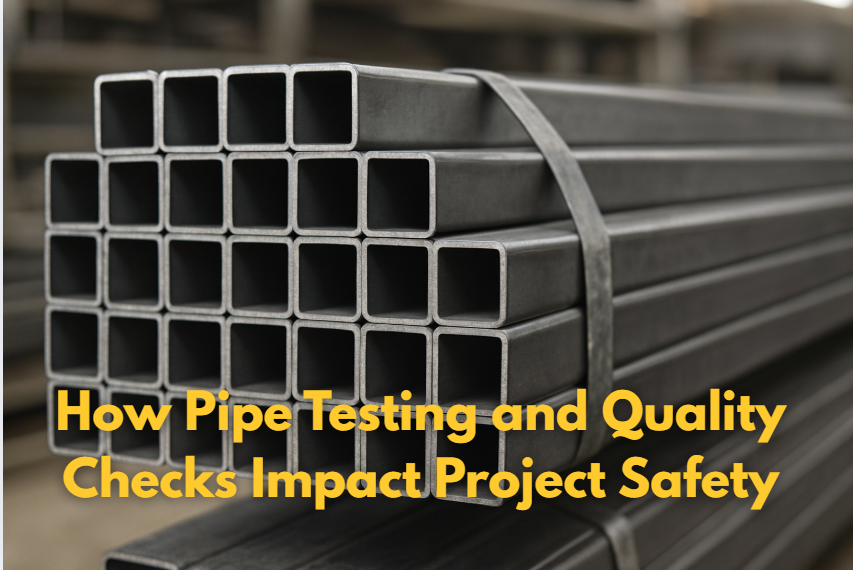
How Pipe Testing and Quality Checks Impact Project Safety is a critical topic for construction, industrial, and infrastructure projects where material failure can lead to safety risks, delays, and financial loss. Proper testing and quality checks ensure that GI and MS pipes meet strength, pressure, and durability requirements before installation. This blog explains how testing protects workers, structures, and long-term project performance, and why sourcing from trusted distributors like Khandelwal Pipe Syndicate makes a measurable difference.
Contents
- 1 TL;DR
- 2 Introduction: Why Pipe Testing Is a Safety Issue Not a Formality
- 3 Understanding Pipe Testing in Real-World Projects
- 4 Types of Pipe Testing That Influence Project Safety
- 5 Why Quality Checks at the Distributor Level Matter
- 6 Common Risks When Pipe Testing Is Ignored
- 7 Why Safety-Critical Projects Demand Tested Pipes
- 8 Role of Standards and Certifications
- 9 Difference in Testing Requirements for GI and MS Pipes
- 10 Role of Hydrostatic and Pneumatic Testing
- 11 Importance of Weld Quality Inspection
- 12 Storage and Handling Tests That Affect Safety
- 13 Third-Party Inspection and Its Safety Value
- 14 How Testing Prevents Long-Term Safety Failures
- 15 Impact on Compliance and Legal Safety Obligations
- 16 Why Distributors Play a Safety Gatekeeper Role
- 17 Summary of Safety Benefits from Proper Testing
- 18 Site-Level Checks and Installation Practices That Protect Safety
- 19 Importance of Pre-Installation Inspection at Site
- 20 Alignment and Joint Testing During Installation
- 21 On-Site Weld Testing and Safety Assurance
- 22 Pressure Testing After Installation
- 23 Environmental and Load Testing Considerations
- 24 Human Safety and Worker Protection
- 25 Documentation and Traceability at Site
- 26 Consequences of Skipping Site-Level Quality Checks
- 27 Why Safety Is a System Responsibility
- 28 Long-Term Project Risk Reduction Through Quality Control
- 29 Regulatory Compliance and Legal Protection
- 30 Role of Reliable Distributors in Safety Assurance
- 31 Cost of Ignoring Testing and Quality Checks
- 32 Conclusion
- 33 FAQs: How Pipe Testing and Quality Checks Impact Project Safety
TL;DR
- How Pipe Testing and Quality Checks Impact Project Safety starts before pipes reach the site
- Testing verifies strength, thickness, pressure capacity, and coating quality
- Poorly tested pipes increase risks of leaks, collapse, and accidents
- Quality checks reduce project failures and long-term maintenance costs
- Certified testing is essential for compliance and worker safety
- Distributors like Khandelwal Pipe Syndicate ensure tested and verified supply
Introduction: Why Pipe Testing Is a Safety Issue Not a Formality
In modern construction and industrial development, safety is not only about helmets, signage, or protocols on-site. One of the most overlooked safety factors is material reliability. This is where How Pipe Testing and Quality Checks Impact Project Safety becomes highly relevant.
Pipes form the backbone of water supply systems, fire safety lines, industrial fluid networks, gas transportation, and structural frameworks. If a pipe fails due to poor material quality, incorrect thickness, or inadequate testing, the consequences can include flooding, fire system failure, structural collapse, injury, or even loss of life.
Despite this, many projects still treat testing as a formality rather than a safety-critical process. Understanding How Pipe Testing and Quality Checks Impact Project Safety helps buyers, engineers, and contractors make informed sourcing decisions that protect people, assets, and timelines.
Trusted distributors such as Khandelwal Pipe Syndicate play a key role by ensuring that only tested, certified, and compliant GI and MS pipes reach project sites.
Quick read on How Storage & Handling Impact GI & MS Pipe Quality
Understanding Pipe Testing in Real-World Projects
To fully grasp How Pipe Testing and Quality Checks Impact Project Safety, it is important to understand what pipe testing actually involves. Pipe testing is a systematic process of verifying whether a pipe meets defined mechanical, dimensional, and safety standards before installation.
Pipe testing is not limited to factories. It happens at multiple stages:
- During manufacturing
- At distributor warehouses
- Before dispatch
- During third-party inspection
- Sometimes at the project site
Each step contributes directly to How Pipe Testing and Quality Checks Impact Project Safety, reducing the risk of defective material entering critical systems.
Types of Pipe Testing That Influence Project Safety
1. Dimensional and Thickness Testing
One of the most basic yet critical checks under How Pipe Testing and Quality Checks Impact Project Safety is dimensional accuracy.
This includes verifying:
- Outer diameter
- Wall thickness
- Length tolerance
- Roundness and straightness
Even minor deviations can cause joint failure, leakage, or stress concentration. For example, thinner-than-specified GI pipes in fire systems may burst under pressure, directly compromising safety.
Distributors like Khandelwal Pipe Syndicate ensure that pipes match exact specifications before supply.
2. Mechanical Strength Testing
Mechanical testing directly defines How Pipe Testing and Quality Checks Impact Project Safety because it confirms whether pipes can withstand real-world loads.
Common tests include:
- Tensile strength testing
- Yield strength verification
- Elongation testing
- Impact resistance
MS pipes used in structural frameworks must meet load-bearing requirements. Without these tests, structures risk bending, cracking, or collapse.
3. Pressure Testing
Pressure testing is one of the strongest contributors to How Pipe Testing and Quality Checks Impact Project Safety, especially for:
- Water pipelines
- Fire-fighting systems
- Gas lines
- Industrial fluid transport
Hydrostatic or pneumatic tests ensure pipes do not leak, deform, or burst under operating pressure. A failed pressure test is a clear indicator of unsafe material.
Projects sourcing from Khandelwal Pipe Syndicate benefit from pressure-tested pipes suitable for critical systems.
4. Coating and Corrosion Resistance Testing
For GI pipes, zinc coating quality directly affects How Pipe Testing and Quality Checks Impact Project Safety.
Key checks include:
- Coating thickness
- Uniformity of galvanization
- Adhesion strength
- Resistance to peeling or cracking
Poor coating leads to early corrosion, pipe weakening, contamination of water, and system failure. Over time, this creates safety hazards in buildings, factories, and public infrastructure.
Why Quality Checks at the Distributor Level Matter
Many buyers assume that testing only happens at the manufacturing stage. In reality, How Pipe Testing and Quality Checks Impact Project Safety depends heavily on distributor-level inspection.
Pipes can be damaged during:
- Transportation
- Storage
- Improper stacking
- Exposure to moisture
Reputable distributors like Khandelwal Pipe Syndicate conduct inward quality checks to identify:
- Bent or oval pipes
- Surface defects
- Damaged coatings
- Inconsistent thickness
This additional layer of inspection significantly strengthens How Pipe Testing and Quality Checks Impact Project Safety by stopping defective material before it reaches the site.
Common Risks When Pipe Testing Is Ignored
Understanding How Pipe Testing and Quality Checks Impact Project Safety also means recognizing what happens when testing is skipped.
Projects that compromise on testing often face:
- Leakage in water and gas lines
- Failure of fire safety systems
- Structural instability
- Costly rework and replacements
- Safety hazards to workers and occupants
- Legal and compliance issues
In extreme cases, poorly tested pipes have caused flooding, fire spread, and industrial accidents. These risks make testing non-negotiable.
Why Safety-Critical Projects Demand Tested Pipes
Certain applications make How Pipe Testing and Quality Checks Impact Project Safety even more critical:
- Fire hydrant and sprinkler systems
- Gas distribution networks
- Industrial pressure pipelines
- Structural supports and scaffolding
- Public water supply systems
In these applications, pipe failure is not just a maintenance issue—it is a direct safety threat.
This is why engineers prefer sourcing from experienced distributors like Khandelwal Pipe Syndicate, who understand application-specific testing requirements.
Role of Standards and Certifications
Standards act as the backbone of How Pipe Testing and Quality Checks Impact Project Safety.
In India, tested pipes typically comply with:
- IS 1239
- IS 3589
- IS 1161
- IS 4923
These standards define minimum requirements for strength, dimensions, pressure, and coating. Certified pipes reduce uncertainty and ensure predictable performance.
Difference in Testing Requirements for GI and MS Pipes
One reason How Pipe Testing and Quality Checks Impact Project Safety is often misunderstood is because GI and MS pipes are tested differently based on their intended use.
Testing Focus for GI Pipes
GI pipes are primarily used in water supply, fire safety systems, outdoor installations, and environments where corrosion resistance is critical. Testing for GI pipes focuses on:
- Zinc coating thickness and uniformity
- Adhesion strength of galvanization
- Corrosion resistance performance
- Dimensional accuracy for threaded joints
- Pressure tolerance for water and fire lines
If galvanization quality is poor, rust develops quickly, weakening the pipe and contaminating water systems. This is why How Pipe Testing and Quality Checks Impact Project Safety is especially important for GI pipes used in public and residential projects.
Testing Focus for MS Pipes
MS pipes are widely used in structural frameworks, fabrication, industrial pipelines, and load-bearing systems. Their testing emphasizes mechanical strength rather than corrosion protection.
Key MS pipe tests include:
- Tensile strength verification
- Yield strength and elongation testing
- Weld seam integrity checks
- Impact resistance testing
- Thickness consistency
Inadequate testing in MS pipes can lead to structural bending, weld failure, or collapse under load. This makes How Pipe Testing and Quality Checks Impact Project Safety a decisive factor in construction and industrial safety.
Role of Hydrostatic and Pneumatic Testing
One of the most direct ways How Pipe Testing and Quality Checks Impact Project Safety is through pressure testing. Hydrostatic and pneumatic tests simulate real operating conditions before installation.
Why Pressure Testing Matters
Pressure testing helps confirm:
- Leak-free performance
- Resistance to internal stress
- Stability under sudden pressure surges
- Safety margins during emergencies
For example, fire-fighting pipelines experience sudden pressure spikes. If pipes are not pressure-tested properly, they may rupture during emergencies, putting lives at risk. This demonstrates clearly How Pipe Testing and Quality Checks Impact Project Safety beyond theoretical compliance.
Importance of Weld Quality Inspection
Many failures in MS pipe systems occur not because of pipe material but due to poor welding. This is another area where How Pipe Testing and Quality Checks Impact Project Safety becomes evident.
Weld inspection checks for:
- Incomplete fusion
- Porosity
- Cracks
- Misalignment
- Weak weld seams
Non-destructive testing methods such as visual inspection, ultrasonic testing, or radiography help identify hidden defects. Pipes with weak welds may fail suddenly under load, especially in scaffolding or industrial frameworks.
Storage and Handling Tests That Affect Safety
Testing does not end at manufacturing. How Pipe Testing and Quality Checks Impact Project Safety also depends on how pipes are stored and handled before dispatch.
Pipes stored incorrectly may develop:
- Bends and ovality
- Surface dents
- Coating damage
- Internal moisture accumulation
Reputable distributors perform visual and dimensional checks before dispatch to ensure storage-related damage does not compromise safety. This step is often ignored by unorganized sellers, increasing site-level risks.
Third-Party Inspection and Its Safety Value
Third-party inspection is a critical element of How Pipe Testing and Quality Checks Impact Project Safety, especially in government, infrastructure, and large industrial projects.
Independent inspection agencies verify:
- Compliance with IS standards
- Accuracy of manufacturer test certificates
- Random sample testing results
- Batch traceability
These inspections reduce conflict between suppliers and contractors while ensuring only compliant pipes are installed. This significantly improves safety accountability across projects.
How Testing Prevents Long-Term Safety Failures
One overlooked aspect of How Pipe Testing and Quality Checks Impact Project Safety is long-term performance. Pipes may pass initial installation but fail years later if testing was inadequate.
Testing helps prevent:
- Gradual corrosion-induced collapse
- Hidden fatigue cracks
- Progressive leakage
- Structural weakening over time
Long-term safety is particularly critical in public buildings, hospitals, factories, and high-rise structures where pipe replacement is complex and risky.
Impact on Compliance and Legal Safety Obligations
Regulatory compliance is directly tied to How Pipe Testing and Quality Checks Impact Project Safety. Many safety codes require proof of testing and certification.
Failure to use tested pipes can result in:
- Rejection during inspections
- Project shutdowns
- Insurance claim denial
- Legal liability after accidents
Documented testing ensures traceability and legal protection for builders, engineers, and distributors.
Why Distributors Play a Safety Gatekeeper Role
Even the best manufacturing tests lose value if substandard material enters the supply chain later. This is why distributor-level checks strengthen How Pipe Testing and Quality Checks Impact Project Safety.
A responsible distributor:
- Verifies test certificates
- Inspects physical condition
- Ensures correct grade supply
- Prevents mixing of batches
This gatekeeping role is essential for safety-critical projects where even one defective pipe can compromise the entire system.
Summary of Safety Benefits from Proper Testing
To reinforce How Pipe Testing and Quality Checks Impact Project Safety, proper testing delivers:
- Reduced accident risk
- Stable system performance
- Predictable service life
- Lower maintenance intervention
- Safer working environments
These outcomes are not optional—they are fundamental to responsible construction and industrial practice.
Site-Level Checks and Installation Practices That Protect Safety
Understanding How Pipe Testing and Quality Checks Impact Project Safety does not stop at manufacturing or distribution. A significant portion of safety risk emerges at the site level—during unloading, inspection, installation, and commissioning. Even a fully tested pipe can become unsafe if site-level quality checks are ignored.
Importance of Pre-Installation Inspection at Site
Before installation begins, every pipe should undergo basic site inspection. This step reinforces How Pipe Testing and Quality Checks Impact Project Safety by identifying transit or handling damage that may not appear in factory test reports.
Site inspection typically checks:
- Visible dents, bends, or ovality
- Surface cracks or coating damage
- Thread damage or end deformation
- Rust formation due to moisture exposure
- Length and diameter conformity
Skipping this step can allow damaged pipes into critical systems, increasing the chance of leaks, structural failure, or pressure loss.
Alignment and Joint Testing During Installation
Incorrect alignment is a silent risk factor that explains How Pipe Testing and Quality Checks Impact Project Safety during installation. Misaligned joints introduce stress concentrations that weaken pipes over time.
Quality checks during installation include:
- Ensuring axial alignment before joint tightening
- Confirming correct torque on threaded joints
- Checking weld penetration and bead uniformity
- Avoiding forced fitment that stresses pipe walls
Poor joint alignment may not fail immediately but can cause fatigue cracking under vibration, pressure, or thermal expansion.
On-Site Weld Testing and Safety Assurance
For MS pipe systems, welding quality directly impacts safety. On-site welding requires verification even if pipes were factory-tested. This reinforces How Pipe Testing and Quality Checks Impact Project Safety in fabrication-heavy projects.
On-site weld checks involve:
- Visual weld inspection
- Slag removal and crack detection
- Random non-destructive testing where required
- Confirmation of welding rod compatibility
Unchecked welds are a common cause of scaffolding collapse, structural deformation, and industrial pipeline leakage.
Pressure Testing After Installation
One of the strongest demonstrations of How Pipe Testing and Quality Checks Impact Project Safety is post-installation pressure testing. This ensures the entire system—not just individual pipes—performs safely.
Post-installation tests confirm:
- Leak-free joints
- Uniform pressure distribution
- Absence of weak points
- System readiness for operation
Fire-fighting lines, water supply networks, and industrial pipelines must undergo pressure testing before commissioning to avoid catastrophic failures.
Environmental and Load Testing Considerations
Projects often operate under varying environmental conditions. Understanding How Pipe Testing and Quality Checks Impact Project Safety requires accounting for these real-world factors.
Critical checks include:
- Expansion allowance for temperature changes
- Load testing for overhead or vertical pipes
- Vibration tolerance in machinery-connected pipelines
- Corrosion risk in humid or coastal areas
Ignoring environmental impact can shorten pipe lifespan and compromise safety even when initial tests were passed.
Human Safety and Worker Protection
One overlooked aspect of How Pipe Testing and Quality Checks Impact Project Safety is worker safety during installation and operation.
Proper testing reduces:
- Pipe bursts during pressure loading
- Sudden joint separation
- Structural collapse during erection
- Exposure to hazardous leaks
Tested and certified pipes create a safer working environment for engineers, welders, and maintenance staff.
Documentation and Traceability at Site
Traceability reinforces How Pipe Testing and Quality Checks Impact Project Safety by ensuring accountability.
Site teams should maintain:
- Manufacturer test certificates
- Batch identification records
- Inspection logs
- Pressure test reports
This documentation is critical for audits, insurance validation, and future maintenance planning.
Consequences of Skipping Site-Level Quality Checks
Projects that ignore site checks often experience:
- Early-stage failures
- Costly rework
- Safety incidents
- Regulatory non-compliance
These outcomes highlight why How Pipe Testing and Quality Checks Impact Project Safety must be addressed beyond factory testing alone.
Why Safety Is a System Responsibility
Safety is not the responsibility of a single stakeholder. Manufacturers, distributors, contractors, and site engineers all influence How Pipe Testing and Quality Checks Impact Project Safety.
Each layer of inspection reduces risk and increases reliability across the entire project lifecycle.
Long-Term Project Risk Reduction Through Quality Control
When evaluating How Pipe Testing and Quality Checks Impact Project Safety, the biggest benefit lies in long-term risk reduction. Projects rarely fail on day one. Most failures occur months or years later due to hidden defects, weak joints, or poor-quality material that passed unchecked.
Proper testing and quality checks help prevent:
- Unexpected pipe bursts
- Structural weakening over time
- Fire system failures during emergencies
- Water contamination in supply networks
- Legal disputes and insurance rejections
In large-scale infrastructure and industrial projects, even a single pipe failure can disrupt operations, endanger lives, and cause financial loss. This is why understanding How Pipe Testing and Quality Checks Impact Project Safety is no longer optional—it is a core project requirement.
Regulatory Compliance and Legal Protection
Another critical aspect of How Pipe Testing and Quality Checks Impact Project Safety is regulatory compliance. Government bodies, insurance agencies, and safety auditors increasingly demand proof of material testing and certification.
Projects using untested or undocumented pipes risk:
- Project shutdowns
- Penalties for non-compliance
- Rejection during safety audits
- Loss of insurance coverage
Tested pipes with proper documentation protect project owners legally and financially. This is especially important in fire safety systems, public infrastructure, and industrial facilities.
Role of Reliable Distributors in Safety Assurance
Even the best testing standards fail if materials are sourced from unreliable channels. This is why distributors play a crucial role in How Pipe Testing and Quality Checks Impact Project Safety.
Trusted distributors ensure:
- Pipes are sourced only from certified manufacturers
- Test certificates and batch details are provided
- Storage and handling preserve pipe quality
- Only compliant material reaches project sites
Khandelwal Pipe Syndicate supports project safety by supplying tested, certified GI and MS pipes with full documentation, helping clients maintain compliance and performance standards throughout the project lifecycle.
Cost of Ignoring Testing and Quality Checks
Ignoring How Pipe Testing and Quality Checks Impact Project Safety may appear cost-saving initially, but it leads to higher long-term expenses such as:
- Replacement costs
- System downtime
- Emergency repairs
- Legal liabilities
- Reputation damage
In contrast, investing in tested materials improves asset lifespan, reduces maintenance costs, and ensures uninterrupted operations.
Conclusion
Understanding How Pipe Testing and Quality Checks Impact Project Safety is essential for anyone involved in construction, infrastructure, industrial, or utility projects. From manufacturing tests to site-level inspections, each quality check reduces risk and strengthens system reliability.
Projects built with tested and certified pipes perform better, last longer, and protect both people and property. Safety is not achieved by chance—it is built through discipline, verification, and responsible sourcing.
For projects that demand reliability, compliance, and long-term safety, sourcing from experienced and quality-focused suppliers makes all the difference
Ensure your projects meet the highest safety standards.
Partner with Khandelwal Pipe Syndicate for tested, certified GI and MS pipes that support safe, compliant, and durable project execution.
Contact the team today to source pipes you can trust.
FAQs: How Pipe Testing and Quality Checks Impact Project Safety
1. Why is pipe testing important for project safety?
Pipe testing verifies strength, pressure tolerance, and defect-free material, directly supporting How Pipe Testing and Quality Checks Impact Project Safety.
2. What types of tests are commonly done on GI and MS pipes?
Common tests include hydrostatic testing, tensile testing, coating thickness checks, and dimensional verification.
3. Can untested pipes cause safety failures?
Yes. Untested pipes increase the risk of leaks, bursts, and structural collapse, proving How Pipe Testing and Quality Checks Impact Project Safety.
4. Are site-level inspections necessary even after factory testing?
Yes. Site inspections detect handling damage and installation errors that factory tests cannot identify.
5. Do tested pipes cost more?
Tested pipes may cost slightly more upfront but save significantly by reducing failures and maintenance costs.
6. How does pressure testing improve safety?
Pressure testing ensures joints and systems can handle real operating conditions safely.
7. Are tested pipes mandatory for fire safety systems?
Yes. Fire safety codes require tested and certified pipes to prevent system failure during emergencies.
8. What documents should buyers ask for when purchasing pipes?
Buyers should request test certificates, batch details, and IS compliance documentation.
9. How does distributor quality affect pipe safety?
Reliable distributors ensure only tested and certified pipes reach project sites, reinforcing How Pipe Testing and Quality Checks Impact Project Safety.
10. Who should prioritize pipe testing the most?
Builders, contractors, industrial operators, and infrastructure developers should prioritize testing to protect lives and assets.