
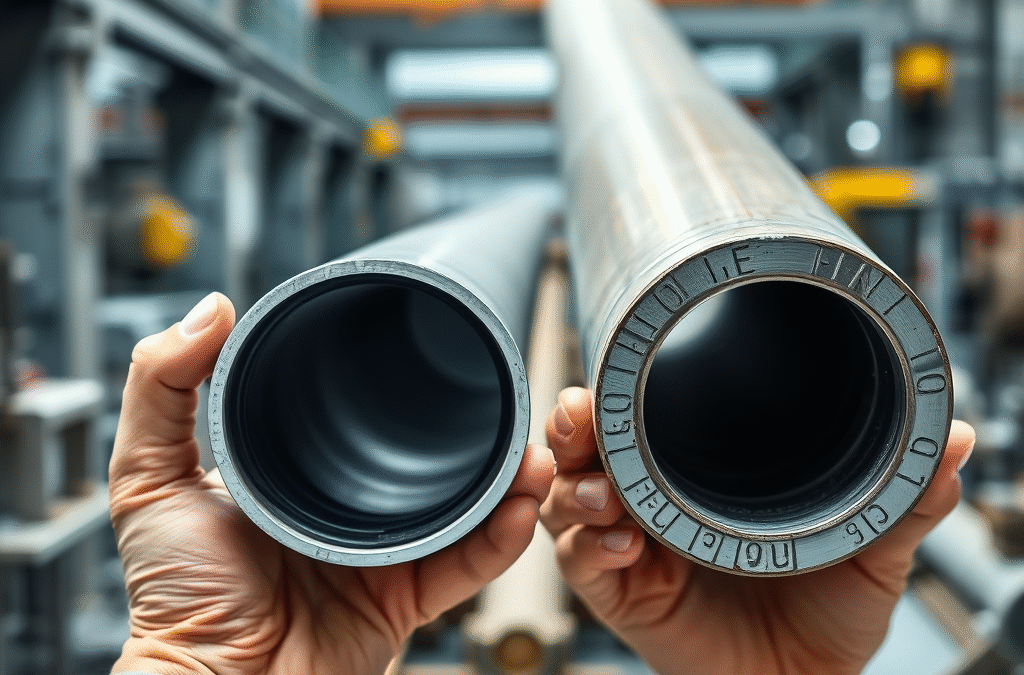
Welded pipes are made by rolling metal sheets and joining the edges, while seamless pipes are created from a solid billet that is pierced to form a hollow tube. The main difference lies in how the seam is formed, which affects strength, cost, and applications. This guide explains the manufacturing types, pros, cons, and how to choose the right pipe.
Contents
- 1 What is a pipe and why does it matter?
- 2 How are pipes made? An overview of pipe manufacturing types
- 3 Seamless pipe manufacturing process
- 4 Welded pipe manufacturing process
- 5 welded vs seamless pipes: Main differences
- 6 Key factors that decide the right pipe type1. Operating pressure – If the system runs above 1,500 psi, seamless is usually safer.
- 7 Common applications of welded vs seamless pipes
- 8 Pros and cons of each type
- 9 Maintenance and inspection tips
- 10 Cost comparison – What to expect
- 11 How to read pipe specifications
- 12 Frequently asked questions
- 13 Practical steps to choose the right pipe
- 14 Final thoughts
- 15 FAQs
What is a pipe and why does it matter?
A pipe is a hollow cylinder that moves fluids, gases, or solids. Pipes are used in water supply, oil, gas, HVAC, and many other industries. The way a pipe is made decides its strength, price, and where it can be used.
Basic parts of a pipe
- Outer diameter – the outside width of the pipe
- Wall thickness – how thick the pipe wall is
- Length – how long the pipe is before it is cut
- Seam or no seam – whether the pipe has a welded joint or not
Understanding these parts helps you compare welded vs seamless pipes.
How are pipes made? An overview of pipe manufacturing types
There are several ways to make a pipe. The most common methods are:
- Seamless pipe production
- Welded pipe production 3. Cold drawing and cold rolling
- Extrusion for special shapes
Each method starts with a raw metal piece. The raw piece is shaped, heated, and formed into a tube. The final step decides whether the tube has a seam.
Seamless pipe manufacturing process
Step 1 – Billet selection
A round or square metal billet is chosen. The material can be carbon steel, stainless steel, alloy steel, or other metals.
Step 2 – Heating
The billet is heated to over 1,200 °C. This makes the metal soft enough to be pierced.
Step 3 – Piercing
A mandrel or piercing mill pushes through the hot billet. The result is a hollow “shell” called a pipe shell.
Step 4 – Forming
The shell is stretched, reduced, and straightened. It may be further heated to improve shape.
Step 5 – Finishing
The pipe receives surface treatment, cutting, threading, or coating. It is then inspected for defects.
Seamless pipes have no welded joint. The material is continuous from the inside to the outside. This gives them uniform strength and high pressure resistance.
Welded pipe manufacturing process
Welded pipes start as flat metal plates or coils. The steps are:
- Plate or coil preparation – The metal is cut to the required width.
- Edge conditioning – The edges are cleaned and shaped for welding.
- Forming the tube – The plate is rolled into a cylindrical shape.
- Welding the seam – The edges are joined by heating and pressure (ERW), laser, or resistance welding.
- Sizing and finishing – The pipe is passed through rollers to achieve the final diameter and wall thickness.
- Inspection – Ultrasonic or radiographic testing checks for weld defects.
Welded pipes can be made in many sizes quickly and at lower cost.
welded vs seamless pipes: Main differences
The key differences between welded and seamless pipes are:
| Feature | Seamless pipe | Welded pipe |
|———|—————|————-|
| Production method | Pierced from a solid billet | Rolled from a flat plate |
| Presence of a seam | No seam | Has a longitudinal weld |
| Pressure rating | Generally higher | Slightly lower |
| Typical applications | High‑pressure oil, gas, power | Water, low‑pressure oil, structural use |
| Cost | Higher per unit | Lower per unit |
| Size range | Up to large diameters, but limited by billet size | Very large diameters possible |
| Surface quality | Smooth interior, no weld marks | May have weld flash or seam marks |
Choosing between welded and seamless pipes depends on pressure, budget, and application.
Key factors that decide the right pipe type1. Operating pressure – If the system runs above 1,500 psi, seamless is usually safer.
- Temperature range – Seamless handles extreme heat better.
- Fluid type – Corrosive fluids may need special alloy or lining.
- Size needed – Very large diameters are often welded.
- Budget constraints – Cost‑sensitive projects may choose welded.
- Inspection access – Welded seams can be inspected with ultrasonic tests.
Ask yourself these questions before ordering a pipe.
Common applications of welded vs seamless pipes
- Oil and gas pipelines – Seamless pipes are used for high‑pressure transport.
- Water distribution – Welded steel or PVC pipes are common for municipal water.
- Automotive exhaust – Welded stainless steel pipes are used for mufflers.
- Power plant boilers – Seamless alloy pipes carry steam at high temperature.
- Construction scaffolding – Hollow structural sections are often welded for ease of fabrication.
Understanding the application helps you avoid over‑ or under‑specifying a pipe.
Pros and cons of each type
Seamless pipe – Advantages
- Uniform strength around the circumference. – No weld‑related weak points. – Higher pressure rating.
- Smooth interior reduces friction loss.
Seamless pipe – Disadvantages
- More expensive because of material waste.
- Limited to sizes that can be cast from a billet.
- Longer lead time for large diameters.
Welded pipe – Advantages
- Lower cost per foot. – Can be produced in very large diameters.
- Faster production rate.
- Easy to join multiple sections with welding. ### Welded pipe – Disadvantages- The weld seam can be a source of corrosion.
- Slightly lower pressure rating.
- Interior may have weld flash that increases friction.
Maintenance and inspection tips
- Visual inspection – Look for cracks, corrosion, or weld defects.
- Ultrasonic testing – Detects hidden flaws in the wall or weld. – Radiography – Uses X‑ray or gamma rays for deep‑penetration checks.
- Pressure testing – Hydrostatic or pneumatic tests verify strength.
- Corrosion protection – Apply coatings or cathodic protection for welded seams.
Regular inspection extends pipe life and prevents unexpected failures.
Cost comparison – What to expect
| Item | Seamless pipe (per ton) | Welded pipe (per ton) | Typical price difference |
|——|————————|———————–|————————–|
| Raw material | Higher due to billet waste | Lower due to plate use | 20‑30 % higher for seamless |
| Manufacturing labor | More steps, slower | Fewer steps, faster | Adds 10‑15 % cost |
| Inspection | More frequent due to high value | Less frequent | Varies with project |
The price gap shrinks when large volumes are ordered. Always request quotes for both types when budgeting.
How to read pipe specifications
- ASTM A53 – Steel pipe for pressure service (both welded and seamless).
- ASTM A106 – Seamless carbon steel pipe for high‑temperature service.
- ASTM A533 – Welded steel pipe for low‑temperature service.
- ISO 9001 – Quality management standard used by manufacturers.
Specifications tell you the material, pressure rating, temperature limit, and testing requirements. Use them to match a pipe to your system.
Frequently asked questions
Q: Can a welded pipe be used for high‑pressure oil?
A: It can be used if the pressure is below the pipe’s rating and the weld is properly inspected. However, seamless is preferred for pressures above 1,500 psi.
Q: Is seamless pipe always stronger?
A: Not always. Strength depends on material grade, wall thickness, and heat treatment. A high‑grade welded pipe can outperform a low‑grade seamless pipe.
Q: How long does it take to produce a welded pipe?
A: Production can be measured in days for standard sizes. Large custom diameters may take weeks.
Q: What does “ERW” mean in welded pipe?
A: ERW stands for Electric Resistance Welding, a common method for making welded steel pipes.
Q: Can seamless pipes be threaded?
A: Yes. Both seamless and welded pipes can be threaded at the ends for connection.
Q: Are there environmental concerns with pipe manufacturing?
A: Both processes generate scrap metal and energy use. Recycling scrap and using energy‑efficient furnaces reduce impact.
Q: Which pipe type is best for drinking water? A: Stainless steel or carbon steel welded pipes with a clean interior are commonly used for potable water.
Q: Do welded pipes need special coating?
A: If the service environment is corrosive, a coating or cathodic protection is recommended, especially on the weld seam.
Q: Can I join a seamless pipe to a welded pipe?
A: Yes, using a compatible fitting and proper welding or threading technique. Ensure the materials match.
Q: What is the maximum diameter for seamless pipe? A: It depends on the billet size, but typical seamless pipes go up to about 24 inches. Larger diameters are usually welded.
Q: How can I tell if a pipe is welded or seamless visually?
A: Look for a longitudinal seam line on the surface. Seamless pipes have a smooth, uninterrupted wall.
Practical steps to choose the right pipe
- Define the system pressure and temperature.
- Select the material based on fluid type.
- Calculate required wall thickness using codes (ASME, API).
- Check available sizes from manufacturers.
- Compare cost estimates for welded vs seamless options.
- Plan inspection and maintenance strategy. 7. Place the order with clear specifications.
Following these steps reduces risk and saves money.
Final thoughts
Understanding welded vs seamless pipes helps you pick the right product for any project. Consider pressure, budget, size, and application. Use the tips above to make an informed decision and keep your system running safely.
FAQs
What is the main difference between welded and seamless pipes?
A: Seamless pipes have no welded joint, giving them uniform strength. Welded pipes are made from flat plates that are rolled and welded together.
How are seamless pipes manufactured?
A: A hot billet is pierced to create a hollow shell, then the shell is elongated and finished without any seam.
Can welded pipes handle high pressure?
A: They can, but only up to a lower pressure limit than most seamless pipes. Proper welding and inspection are required.
What does “pipe manufacturing types” refer to?
A: It describes the different methods used to produce pipes, including seamless, welded, cold‑drawn, and extruded processes.
Is seamless pipe more expensive than welded pipe?
A: Generally yes, because of material waste and fewer production steps.
How do I inspect a welded seam?
A: Use ultrasonic or radiographic testing to detect internal flaws in the weld.
What applications favor welded pipes?
A: Low‑pressure water systems, structural scaffolding, and large‑diameter transport lines.
Do seamless pipes need any special coating?
A: Not always, but corrosion‑prone environments may require coating for both seamless and welded pipes.
Can I use a seamless pipe for a residential water line?
A: Yes, if the size and pressure rating match the residential requirements.
What standards govern pipe manufacturing?
A: Standards such as ASTM A53, ASTM A106, and ISO 9001 define material, testing, and quality requirements.